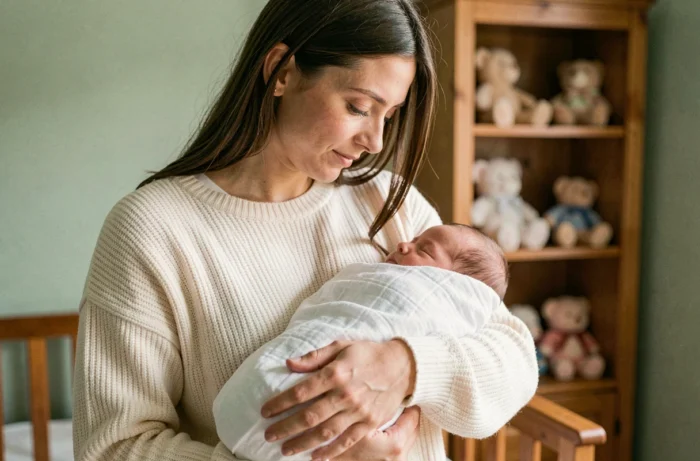
The development of a baby from birth to twelve months follows a common sequence for all children, even though the pace varies from one individual to another. Each acquisition, whether motor, sensory, or linguistic, relies on the gradual maturation of the central nervous system and the quality of interactions with the surrounding environment. Understanding these mechanisms allows parents to recognize their child’s progress and adapt their responses to their real needs.
Brain circuits and early interactions: the engine of baby development
An infant’s brain forms new neural circuits with every exchange with its environment. A sustained gaze, a familiar voice, skin-to-skin contact trigger connections that gradually structure perception, memory, and emotional regulation. These interactions, sometimes referred to as serve and return interactions, constitute the main fuel for brain development during the first year of life.
Baby development begins well before birth. Research on the fetal period shows that the fetus already possesses motor, sensory, and cognitive abilities that follow the same sequencing for all children. This continuity between prenatal and postnatal life explains why a newborn recognizes their parents’ voices within the first hours.
To delve deeper into each stage and find concrete monthly milestones, parents can visit futuremaman.fr for baby and consult age-appropriate guides for their child.
Physiological needs of the infant: sleep, nutrition, safety
Three pillars support a baby’s physical growth and well-being: sufficient sleep, age-appropriate nutrition, and a secure environment. Neglecting any of these aspects hinders motor and cognitive acquisitions, as the body then focuses its resources on survival rather than learning.
Baby sleep and room sharing
A newborn sleeps most of the day, with short cycles that gradually lengthen. Recommendations from Assurance Maladie and Santé publique France clearly distinguish room sharing (baby in their own bed placed in the parents’ room) from bed sharing, which is discouraged. This distinction is often misunderstood, yet it is a central point in preventing sudden infant death syndrome.
Food diversification and allergen management
Exclusive breastfeeding meets the needs of the infant during the first months. When diversification begins, the shape of the foods matters as much as their choice. Round or hard foods (whole grapes, cherry tomatoes, whole nuts) should be avoided in their raw form or prepared in an appropriate manner, and the baby should always eat sitting under the supervision of an adult.
Contrary to a long-held belief, common allergens do not need to be systematically delayed. French recommendations indicate that egg, fish, gluten, and peanut in an appropriate form can be introduced at the beginning of diversification. In cases of severe eczema or known allergy, prior medical advice is necessary.
Motor and sensory development between birth and twelve months
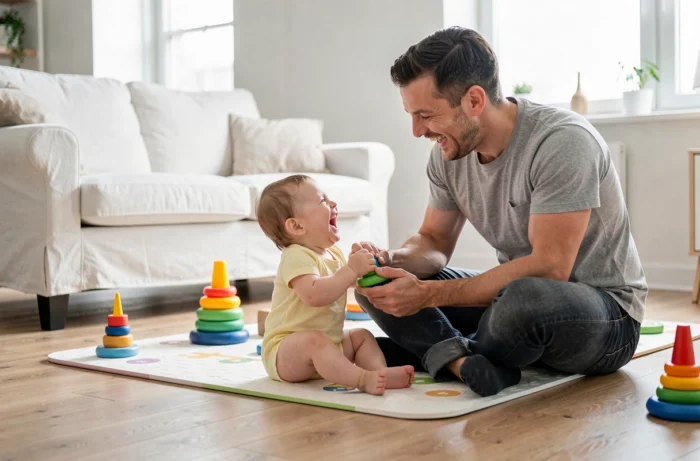
A baby’s motor progression follows a predictable order, from head to feet and from the center of the body to the extremities. This logic, known as cephalocaudal and proximodistal development, explains why an infant first controls their head, then their trunk, before coordinating their hands and legs.
- During the first three months, the baby gradually holds their head up and begins to follow an object with their gaze. Their movements remain uncoordinated, but they recognize familiar voices and smells.
- Between four and six months, hand-eye coordination improves. The baby intentionally grabs objects, rolls from back to stomach, and starts to recognize their name.
- From seven to nine months, sitting without support stabilizes. Crawling or creeping appears, and the baby explores their environment more independently.
- Between ten and twelve months, the first steps occur in some children. The pincer grasp (thumb-index) allows for picking up small objects, and the first recognizable words emerge.
Each child reaches these milestones at their own pace. A delay of a few weeks does not indicate a setback. However, persistent difficulties warrant seeking medical advice rather than waiting for a hypothetical spontaneous catch-up.
Baby’s language and emotions: guidelines for parents
Language does not begin with the first words. From birth, a baby communicates through crying, gazing, and facial expressions. These signals constitute a form of pre-verbal language that parents intuitively decode, and each appropriate response reinforces the communication circuit.
By around three months, vocalizations (cooing, vowel sounds) appear. Between six and nine months, canonical babbling (repetition of syllables like “ba-ba” or “ma-ma”) marks a key stage. This babbling is not random: it reproduces the sounds of the language heard daily, proving that linguistic exposure shapes language development long before the production of real words.
Emotionally, a baby’s ability to regulate their emotions largely depends on the quality of parental responses. An infant whose cries are consistently met develops a better tolerance for frustration over time. This is not about “spoiling” the child, but about providing the necessary security base for exploring the world.
Warning signs and medical monitoring of child development
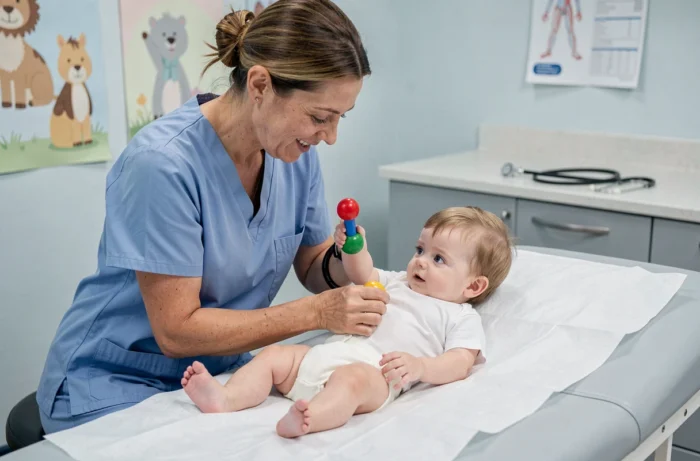
Regular follow-up by a healthcare professional remains the most reliable way to ensure that a baby’s development is progressing normally. Certain signs deserve special attention:
- Absence of eye contact or social smile after three months
- No attempt to grasp an object by five or six months
- No babbling by nine months
- Persistent difficulties with certain food textures or repeated coughing episodes during meals, which may indicate an oral sensitivity disorder
Identifying these signals early allows for early intervention, often more effective than late intervention. The health record and mandatory check-ups provide a structured framework for this monitoring, provided that parents share their observations with the doctor.
The development of a baby is not a race. Monthly milestones serve as a compass, not a stopwatch. What matters more than the speed of acquisition is the consistency of progress and the quality of the emotional environment in which the child grows up.