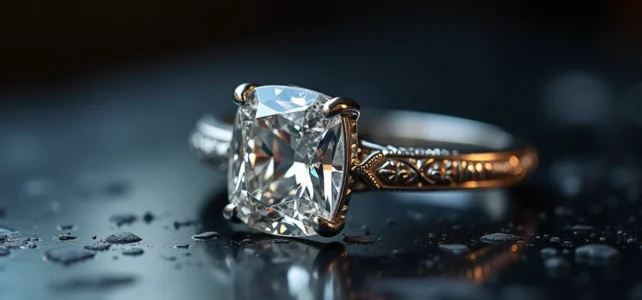
The high jewelry auction market is increasingly focusing on stones whose geological rarity challenges traditional valuation grids. Rings that reach record amounts do not owe their price solely to carat weight: color, provenance, and the historical journey of the gem weigh just as much, if not more, in the final valuation.
Understanding what propels a ring to the top of global sales requires examining the technical and economic mechanisms at play.
How the price of gold reshapes high jewelry
Articles dedicated to record rings focus on the central stone and overlook a factor that is increasingly impacting the final price: the cost of metal. The price per gram of 18-carat gold has reached levels that several jewelry professionals describe as “unattainable luxury.”
This increase has direct consequences on the design of pieces. Houses are adapting their creations with thinner ring bodies, more open structures, and occasional use of alloys or rhodium-plated silver on certain lines. For record pieces, where platinum or solid gold remains the norm, the share of the cost of the stones in the total price mechanically increases.
The work with metal is also becoming more complex. As the body of the ring shrinks, the setting must compensate with precision to securely hold the stone. This recent economic constraint influences how a ring can reach new heights, a parameter that the simple record rankings do not reflect.
Fancy Vivid Color Diamonds: The New Record Axis at Auctions
The world’s most expensive rings are increasingly less likely to feature a colorless diamond. In recent years, the most spectacular increases in auction houses have involved Fancy Vivid color diamonds, particularly blues, pinks, and oranges. These stones proportionally exceed white diamonds in price per carat.
Identifying the most expensive ring in the world often involves tracking this shift. The Wittelsbach-Graff diamond, a deep blue estimated at several tens of millions of dollars, or the Pink Star, an intense pink sold at record auctions, illustrate this trend.
What Makes a Fancy Diamond So Rare
The color of a Fancy diamond comes from anomalies in its crystalline structure at the time of its formation. A boron atom trapped in the carbon lattice produces blue. A deformation of the crystal under geological pressure results in pink. These natural occurrences happen in an infinitesimal fraction of the global production of rough diamonds.
Gemological laboratories like the Gemological Institute of America (GIA) classify these stones on a scale from Faint to Fancy Vivid. Only stones classified as Fancy Vivid reach the peaks at auctions, as they combine maximum saturation and visual purity.
- Fancy Vivid blue diamonds derive their color from traces of boron, a rare element in diamond deposits.
- Pink diamonds owe their hue to a plastic deformation of the crystal, a phenomenon still partially unexplained by geology.
- Pure orange diamonds, without secondary hues, are among the rarest ever extracted.
Ultra-Rare Stones Beyond Diamonds: Kashmir Sapphire and Tanzanite
The shift in records is not limited to color diamonds. Some Kashmir-origin sapphires, recognizable by their characteristic velvety blue, reach carat prices that rival those of Fancy diamonds. Their rarity stems from the near-total depletion of the original deposits, primarily mined in the 19th century.
A certified Kashmir sapphire can exceed a white diamond of the same size in value per carat. This reality disrupts the traditional hierarchy that placed diamonds at the top of all price categories.
Tanzanite, extracted from a unique geographical area in Tanzania, is also generating increasing interest among collectors. Its limited window of exploitation fuels speculation about its future value, even though it has not yet reached the levels of Kashmir sapphires at auction.
Record Auctions and Provenance: How the Price of a Ring is Established
The final price of a record ring relies on a complex interplay of criteria whose interaction is more intricate than simple addition. The 4Cs of diamonds (carat, color, clarity, cut) form the technical foundation, but other variables play a significant role.
The Role of Historical Provenance
A ring that belonged to a royal figure or a celebrity sees its value multiplied compared to a stone of equivalent quality without documented history. Grace Kelly’s engagement ring, signed by Cartier, is a frequently cited example. Historical provenance can represent a significant portion of the final price, sometimes as much as the gemological characteristics of the stone itself.
Auction houses invest heavily in documenting this provenance. Certificates of authenticity, laboratory reports, photographic archives: each element that ties the ring to its history adds a layer of verifiable value.
The Weight of Jewelry Houses in Valuation
The signature of a house like Graff, Cartier, or Van Cleef & Arpels acts as a value multiplier. These houses do not simply mount a stone: they design a setting that maximizes light return, choose a metal that enhances color, and provide a guarantee of traceability that the market recognizes.
- Graff acquired and then recut the Wittelsbach diamond to improve its clarity, a decision that sparked debate in the gemology world but increased the market value of the stone.
- Cartier associates its historical creations with platinum work that has become a technical as well as aesthetic signature.
- Van Cleef & Arpels developed the mystery setting, a technique that hides the prongs and gives the impression that the stones are floating on the jewelry.
The available data do not always allow for a precise distinction between the share of the stone and the share of the signature in the auction price. Auction houses do not break down this detail, and private buyers rarely communicate their exact motivations. What remains observable is that rings signed by major houses consistently dominate the top of the rankings, and this trend shows no signs of slowing down.