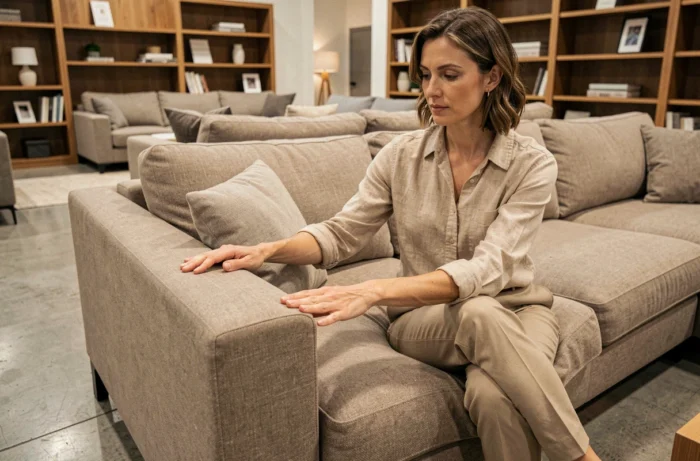
A sofa that sagged after two years costs more than a model sold for double but lasts a decade. The purchase price says almost nothing about the actual longevity. To make the right choice, you need to look beneath the covering, understand what makes up the seat, and check the strength of the structure. Here are the concrete markers that help sort reliable brands from the rest of the market.
Foam density and suspension: the two technical criteria to check in-store
You may have noticed that a sofa can seem comfortable in the store, then sag within a few months? The reason is almost always the seat foam. Its density, expressed in kilograms per cubic meter, determines resistance to sagging over time.
Light foam feels soft at first contact. It deforms quickly under body weight. High-density foam retains its shape much longer. For daily use in the living room, aim for a density high enough to support several hours of sitting per day, over several years.
The suspension plays an equally crucial role. Two systems coexist: elastic straps and springs (either pocketed or biconical). Crossed straps provide soft support, suitable for compact sofas. Pocketed springs, on the other hand, distribute weight independently. Each spring works separately, which limits localized deformations. Comparing these technical characteristics from one manufacturer to another remains the best way to choose a quality sofa.
In-store, a simple test is to sit down and then get back up. If the seat takes several seconds to return to its original shape, the foam lacks resilience. This is a reliable signal, much more than the displayed price.
Sofa structure: solid wood, particle board, or metal
The structure is the skeleton of the sofa. We don’t always think about it because it’s hidden under the fabric or leather. However, it determines the stability and lifespan of the whole.
A solid wood frame (beech, dried pine) withstands wear and tear much better than a particle board frame. Particle board is cheaper to produce, but it poorly tolerates repeated mechanical stresses. Over time, screws loosen, corners warp, and the sofa creaks.
Some manufacturers use a metal frame, especially on convertible models. Metal offers good rigidity, but be cautious of welds: on a frequently used sofa bed, a weak weld can break.
How to check the structure before purchase? Ask for the technical sheet. Serious brands detail the type of wood, the thickness of the frame, and the assembly method (dowels, screws, staples). If a salesperson cannot answer these questions, it’s rarely a good sign.
Fabric, leather, or velvet covering: beyond appearance
The choice of covering depends as much on your lifestyle as on your tastes. A household with children or pets will not have the same constraints as a couple without children.
- Fabric remains the most common choice. It comes in dozens of compositions (cotton, polyester, blended linen). Fabrics with a high abrasion resistance index (Martindale test) better withstand daily wear. The higher the index, the more resistant the fabric is to pilling.
- Full-grain leather ages well and develops a patina over time. It requires regular maintenance (conditioning, protection against drying out). Pigmented leather, more accessible, tolerates stains better but offers a less natural feel.
- Corduroy has gained popularity in recent years. Pleasant to the touch, it marks easily and requires regular brushing to maintain a uniform appearance.
A often overlooked point: removable covers make maintenance easier and extend the lifespan of the sofa. Being able to machine wash the covers after an accidental stain prevents having to replace the entire piece of furniture.
European manufacturing and traceability: what changes for sofa brands
The origin of the sofa directly influences the quality of materials and the controls applied. A sofa made in France, Italy, or Portugal adheres to stricter safety and composition standards than some low-cost imported models.
Italian design remains a reference in the high-end furniture sector, with recognized expertise in leather work and finishes. On the French side, several manufacturers in northern France maintain local production with solid beech structures and high-density foams.
The European ecodesign regulation provides for a digital product passport for furniture, ranked as a second priority by the European Commission. In a few years, a QR code or NFC chip on the sofa will allow access to the origin of materials, repair options, and available spare parts.
This regulatory evolution is already prompting some brands to document their production chain. When making your purchase, prioritize manufacturers who clearly communicate about the origin of the wood, the type of foam, and the assembly location. This transparency is a much more reliable indicator of seriousness than a self-proclaimed marketing label.
Modular sofa or corner sofa: adapting the shape to the use of the living room
The format of the sofa depends on the configuration of your room and how you use it. A corner sofa is suitable for large living rooms oriented towards a screen. A modular model, made up of repositionable elements, adapts to spaces that change function.
Curved sofas are gaining ground. Their arc shape creates a layout oriented towards conversation rather than television. In a multi-use living room (work, reception, games), this configuration offers more flexibility than a classic corner.
For a small living room, a two or three-seater convertible sofa can combine daily seating and occasional sleeping. Check the opening mechanism: a drawer or click-clack system does not offer the same sleeping comfort as a true unfolding mechanism with an integrated mattress.
The choice of a durable sofa relies on simple but rarely performed checks: foam density, type of structure, quality of covering, and manufacturer transparency about its materials. These four points matter more than the brand displayed on the label.