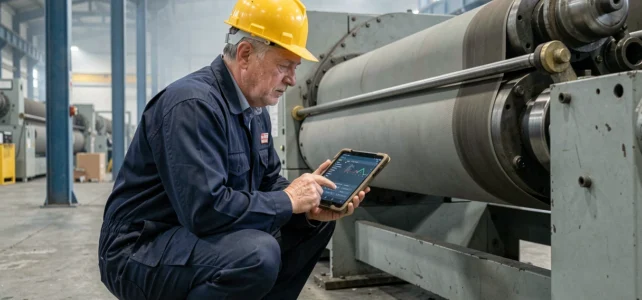
Continuous line maintenance relies on a prerequisite that most maintenance plans overlook: the ability to qualify the state of equipment in real-time while it is producing. Neither CMMS alone nor a traditional preventive schedule meets this requirement. Here, we discuss the technical levers that allow interventions on critical equipment without generating downtime, while integrating regulatory and cyber constraints that will redefine practices in 2026.
Agent-based workflows in predictive maintenance: framing AI autonomy
Maintenance AI is no longer limited to signaling a vibrational or thermal drift. The 2026 architectures are moving towards AI agents capable of triggering complete workflows, from ordering parts to planning interventions, without intermediate manual validation on non-critical actions.
This autonomy poses a concrete problem: an agent that reprograms a lubrication cycle on a production line modifies a process parameter. Without safeguards, it can cause exactly the shutdown we are trying to avoid.
The recommended practices in 2026 impose three safeguards on these agent-based workflows:
- Mandatory human validation for any action modifying a process parameter or a safety threshold, even if the agent has correctly identified the failure
- Comprehensive logging of every decision made by the agent, with timestamps, input data, and algorithmic justification, to ensure traceability in case of an audit
- Limitation of the scope of autonomy by equipment class: an agent can order a standard wear part but cannot modify the setting of a frequency converter without approval from the technical director
This framework transforms the role of field teams. The technician no longer diagnoses: they validate or reject a structured proposal. The time saved on diagnosis more than compensates for the validation loop, and production continues during the arbitration.
Several recent feedbacks documented in specialized literature confirm that this approach to factory maintenance on Airbuzz significantly reduces unplanned interventions, precisely because the agent anticipates the failure before it reaches the critical threshold.

OT network segmentation and the constraints of the Cyber Resilience Act on interventions
OT cybersecurity has become a maintenance planning constraint, not a parallel topic. Intervening on a PLC or updating the firmware of an IoT sensor in production requires traversing segmented network layers, with access rules that did not exist two years ago.
The 2026 frameworks converge towards specific requirements: up-to-date OT inventory, strict network segmentation between IT and OT, secure remote access for service providers, and an operator recovery procedure in case of loss of connection during an intervention.
Impact of the Cyber Resilience Act on the lifecycle of connected equipment
The European Cyber Resilience Act introduces notification obligations related to actively exploited vulnerabilities and serious incidents. Some obligations come into effect as of September 11, 2026, which directly impacts the management of firmware updates in factories.
Specifically, a connected device with a reported vulnerability must undergo a documented update process. When this device is on a production line, the update becomes a full maintenance operation, with the same continuity constraints.
We recommend integrating a recurring slot for OT patch management aligned with reduced production windows into the maintenance plan, rather than waiting for a critical notification that would force a shutdown.
Conditional maintenance in production: arbitrating between embedded sensors and mobile inspections
Predictive maintenance relies on sensor data. Two approaches coexist, and the choice between them determines the actual capacity to maintain without stopping.
Permanent embedded sensors (vibration, temperature, current, pressure) provide a continuous stream. They allow for the detection of a gradual drift over several weeks and enable planning the intervention at the appropriate time. Their limitation: the cost of instrumentation on an old fleet, and the need to maintain the sensors themselves.
Mobile inspections (portable data collectors, thermal cameras, ultrasonic analysis) offer greater flexibility on non-instrumented equipment. However, they only capture a snapshot and miss slow drifts between two passes.
Hybrid strategy by equipment criticality
The arbitration is not done globally but equipment by equipment. On a food processing line, a central compressor justifies permanent instrumentation: its failure stops the entire production. A secondary conveyor falls under quarterly inspection.
- Class A equipment (immediate line shutdown in case of failure): permanent embedded sensors with alert thresholds integrated into the supervision system
- Class B equipment (gradual degradation of quality): monthly mobile inspections, supplemented by a temperature sensor if the cost remains reasonable
- Class C equipment (redundancy available): planned corrective maintenance, with a stock of wear parts sized for quick replacement
This criticality classification allows for concentrating the instrumentation budget where it truly prevents a shutdown, while maintaining the rest of the fleet with less costly but sufficient methods.
Maintenance-production synchronization: the role of the technical director as an arbitrator
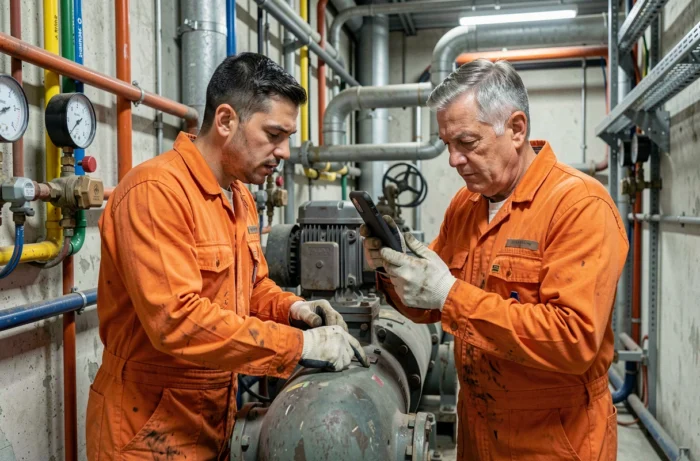
The technical director or maintenance manager who separates their intervention schedule from the production schedule mechanically generates conflicts. The synchronization of both schedules within a single framework is the factor that distinguishes sites capable of maintaining without stopping from those that suffer repeated micro-stops.
The CMMS software must be able to ingest cadence and load data from the lines to propose compatible intervention slots. A series change slot, a cleaning phase in place on a food processing line, a programmed slowdown for quality control: these are exploitable windows for a short preventive intervention.
The process works when the technical director has a consolidated view, not two separate tables. The maintenance and production teams then share the same constraint, and arbitration is done based on data, not on conflicting priorities.
Continuous maintenance does not require spectacular technology. It requires a rigorous classification of equipment, framed AI agents, cyber management integrated into the intervention plan, and above all, a unified schedule between production and maintenance. The site that masters these four points reduces its unplanned stops to a residual level.