
A cat that doesn’t return at the usual time for its meal raises legitimate concern. The distinction between a prolonged escapade and a true disappearance hinges on a simple criterion: the break in routine. A feline that regularly goes out for several hours without issue does not warrant the same reaction as an indoor cat that has been absent since the morning. Understanding this difference allows for an appropriate response and action at the right moment.
Cat Freezing Mode: Why Your Feline Doesn’t Respond When You Call
After a flight or a stressful event, most cats adopt a counterintuitive behavior: they freeze. This freezing mode compels them to remain motionless, silent, sometimes for several days, even just a few meters from their home.
This instinctive reflex explains why shouting their name in the garden rarely works in the first hours. The cat hears you, but its survival instinct tells it not to move. It is not trying to flee further; it is waiting for the perceived danger to disappear.
Owners looking to find out what to do if my cat doesn’t come back often overlook this point: the search should begin very close to home, in silence. A panicked cat hiding under a garden shed or in a neighbor’s garage will not reveal itself spontaneously.
The recommended progression follows concentric circles. First, check every nook and cranny of the house (closets, under furniture, washing machine). Then the garden, hedges, and outdoor shelters. Only after that should you check the immediate neighboring properties. Expanding the search perimeter too quickly is the most common mistake.
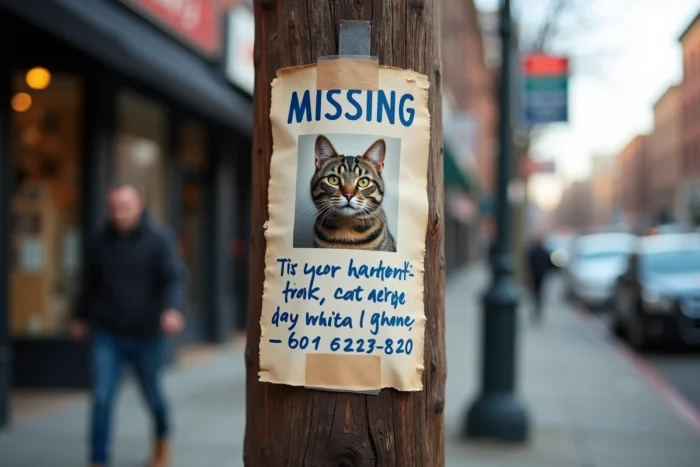
Searching for a Lost Cat: The First Hours Window
The first hours after a disappearance strongly influence the chances of finding a feline. The majority of missing cats remain hidden close to their point of escape. This observation changes the strategy to adopt.
Silent Search at Dusk
A frightened cat is more likely to come out of hiding when the neighborhood is quiet. Dusk or the early hours of the morning provide the best conditions. Approach slowly, with a flashlight pointed at the ground, watching for the reflection of eyes under cars, in bushes, or in spaces under terraces.
Gently shaking a bag of treats or placing a bowl of warm, strongly scented food (tuna, wet food) near the entrance can attract a hungry cat. Warm food releases its scent further than dry kibble.
Olfactory Trap with the Litter Box
Placing the used litter box in front of the door creates a powerful olfactory marker. The familiar smell of its own litter can carry for several dozen meters and helps the disoriented cat find its way back. Some owners add a worn, unwashed piece of clothing nearby to strengthen the signal.
Loss Declaration to I-CAD and Animal Shelter: Important Steps
The loss declaration to I-CAD (identification of domestic carnivores) should occur as soon as the disappearance is noticed. This declaration is made online with the animal’s microchip or tattoo number. Without it, a cat recovered by an individual or a shelter cannot be linked to its owner.
Ensure that your contact information registered with I-CAD is up to date. An outdated phone number or an old address is enough to break the chain of recovery, even if the cat is identified.
- Declare the loss on the I-CAD website with your animal’s identification number, checking your contact details.
- Contact shelters and rescue centers within a close radius of your home. Unclaimed animals are kept there for a limited time before being offered for adoption or, in some facilities, euthanized.
- Report the disappearance on specialized platforms like chat-perdu.org and on the Filalapat app launched by I-CAD.
- Post an alert on social media publicly, with a clear photo and the exact location of the disappearance.
An unidentified cat by microchip or tattoo is legally considered a stray animal. The shelter then has no means to contact the owner. Identification remains the only guarantee of recovery in case of capture.
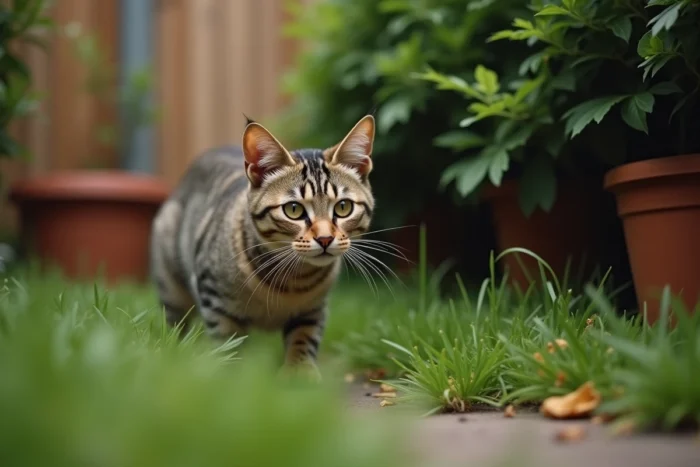
Search Posters in the Neighborhood: Effective Format and Distribution
Physical posters remain an underestimated tool in the digital age. A neighbor who doesn’t check social media may have perfectly spotted your cat in their garden.
An effective poster contains three elements: a color photo of the cat (as clear as possible, ideally from the front and side), the location and date of disappearance, and a phone number that is easily readable from a distance. Avoid long texts. The photo should occupy at least half of the poster.
Distribute the posters in the immediate vicinity: neighbors’ mailboxes, local businesses, veterinary clinics in the area. Veterinarians regularly receive found animals and serve as a concrete relay. Also consider building managers and mail carriers, who cover the neighborhood daily.
Online ads complement the effort but do not replace it. A cat accidentally locked in a neighbor’s garage will be found thanks to a flyer slipped into the mailbox, not through a Facebook post.
Cat Found After Several Days: Signs to Watch for Upon Return
A cat that reappears after a prolonged absence requires special attention. Dehydration, hidden injuries, and post-traumatic stress are not always visible to the naked eye.
Offer fresh water first, then small amounts of wet food. A cat that has gone several days without eating should not ingest a large amount at once, as this could lead to digestive issues. A veterinary examination within 24 hours of return is recommended, even if the cat appears to be in good shape.
Visually inspect the pads (cuts, wear), the eyes (discharge), and gently palpate the body to detect painful areas. A cat that usually allows handling but growls or withdraws from touch indicates a potential injury.
Returning home does not mean an immediate return to normalcy. Limit outdoor access for a few days, allowing the feline to regain its bearings and giving you the chance to observe its eating behavior and activity level.