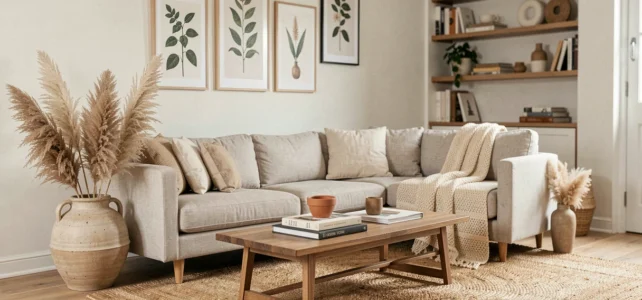
Decorating your home doesn’t necessarily mean pulling out the drill, opening paint cans, or undertaking heavy renovations. An increasing share of recent decor content highlights reversible solutions designed for both renters and cautious homeowners. This article compares categories of decorative items based on their ability to personalize a space without leaving traces.
Reversible decoration: what each category of item really allows
Not all decor accessories are equal when the goal is to transform a room without altering the walls or floors. The table below classifies the main families of items according to three concrete criteria: ease of installation, level of customization, and total reversibility.
| Category of item | Installation without drilling | Customization | Total reversibility |
|---|---|---|---|
| Cushions and textiles (throws, curtains) | Yes | High | Yes |
| Freestanding lamps and light fixtures | Yes | Medium | Yes |
| Adhesive frames and wall galleries | Yes (adhesive strips) | High | Yes, depending on the surface |
| Removable wallpaper | Yes | High | Yes |
| Repurposed objects (jars, crates, fabrics) | Yes | Very high | Yes |
| Wall-mounted shelves | No | High | No |
The dividing line is clear. Textiles and repurposed objects offer the best customization/reversibility ratio, whereas wall shelves, often highlighted in decor magazines, require drilling and patching.
Among the items available on Maison Logo, several categories precisely align with this no-renovation decoration logic, from cushions to light fixtures and lightweight wall accessories.
Textiles and cushions: maximum effect for minimal effort
A cushion does more than make a sofa comfortable. Changing the covers in a living room alters the ambiance of a space in just a few minutes. Textures play a direct role: corduroy evokes a cozy atmosphere, while raw linen leans towards a more minimalist style.
A throw placed on a coffee table or an armchair acts as a design element, not just a thermal accessory. Recent content on interior decoration increasingly treats vintage fabrics and scarves as full-fledged decorative materials.
Curtains, often overlooked, transform the perception of a space. A natural linen curtain hung on a no-drill rod (pressure or tension models) changes the light and visual proportions of a room. The investment remains modest compared to a wall paint job.
Combining textures to create a cohesive ambiance
Rather than multiplying styles, combining two or three textures in the same color palette is enough to give identity to the living room or bedroom. A concrete example: cushions made from reclaimed wood (crates covered in fabric), a thick wool throw, and a lightweight cotton curtain. Three materials, one guiding thread.
Hallways and passage areas: underutilized decorative surfaces
The majority of decor guides focus their advice on the living room, bedroom, or kitchen. Hallways and entries are treated as mere circulation spaces.
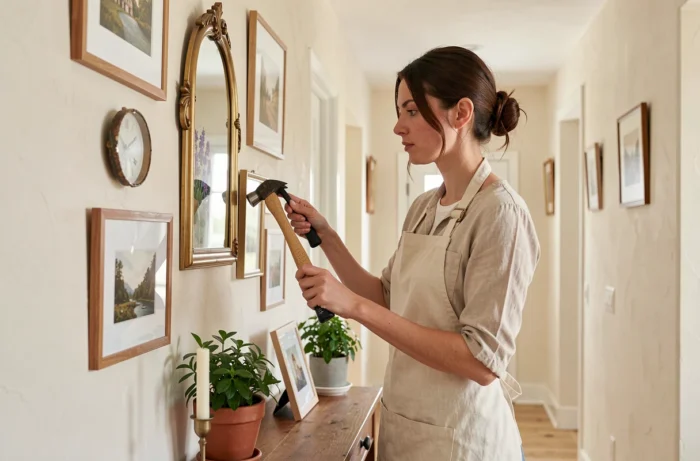
This is a misreading. A hallway often represents several square meters of vertical wall space, perfectly suited for creating a gallery wall without drilling. Lightweight frames secured with repositionable adhesive strips allow for composing and recomposing a visual ensemble over time.
Decorating a hallway transforms the overall perception of a home, as it is the space we traverse most often. Bright niches powered by battery-operated LEDs, compositions of postcards or framed photos, and a mirror placed on the floor against the wall: these elements require neither an electrician nor a drill.
Repurposing everyday objects: personalize without buying decor
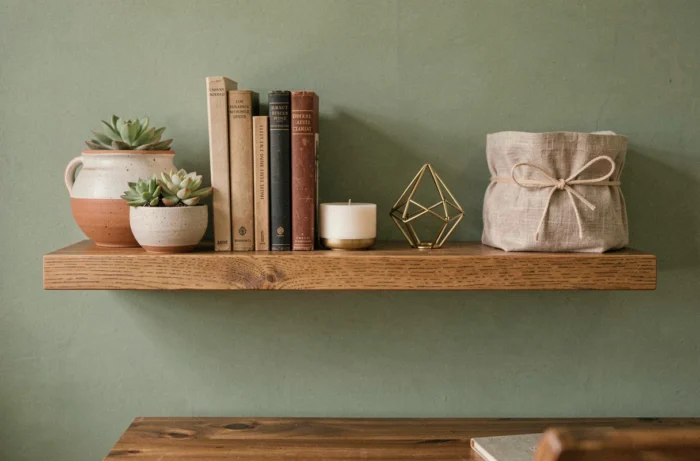
Repurposing objects is an increasingly documented lever for personalization. The logic is simple: use what you already have or what you salvage as decorative material.
- Glass jars lined up on a kitchen shelf or windowsill, filled with grains, spices, or dried flowers, create a focal point without any decor purchase.
- Stacked wooden crates form a modular, movable, and entirely reversible bookshelf.
- A scarf stretched over a lightweight frame replaces a painting, with a textile effect not found in digital prints.
- Terracotta pots, even mismatched, grouped on a wooden tray, create an organic centerpiece.
Repurposing objects produces more unique interiors than buying standard accessories, because each piece tells a personal choice. Recent content on interior decoration associates this approach with visual storytelling: each displayed object says something about the lifestyle of the person living in the space.
Accent lamp and lighting as a design tool
A table lamp does not only serve to illuminate. Positioned on an accent table in a corner of the living room, it creates an ambiance zone that alters the reading of the space. Indirect lighting at seating height changes the atmosphere more than a ceiling light.
Wood, rattan, or ceramic lamps add an extra texture to the room. In contrast, string lights, prevalent in mainstream decor collections, often produce a dated visual effect if not integrated into a broader composition.
Choosing decor items based on the room and desired style
The living room absorbs most of the decoration efforts, but the bedroom and bathroom follow different logics. In the bedroom, a headboard made from fabric stretched over a lightweight wooden frame is a project that can be completed in an hour without drilling. In the bathroom, a wooden tray placed on the bathtub or glass jars for accessories are enough to give character.
Adapting the choice of items to the function of each room avoids the pitfall of a uniformly decorated interior, where each space ends up resembling the others. A living room can focus on cushions and an accent lamp, while a hallway benefits from concentrating efforts on the walls and lighting.
Personalizing an interior does not depend on budget or available space. It relies on targeted item choices, placed without permanent fixtures, combined according to textures and a coherent palette. A single well-chosen cushion can change more than a poorly placed new piece of furniture.