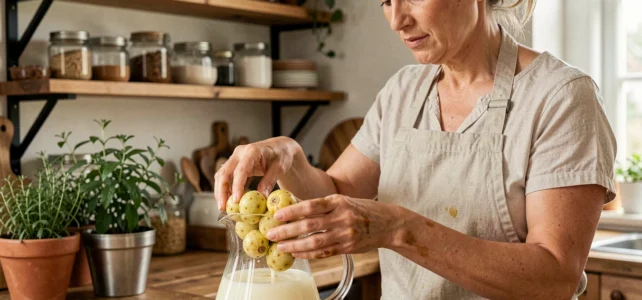
When you harvest your first ripe, translucent noni fruits with a strong smell, the question quickly arises: long fermentation or quick blending? The choice of method determines the taste, preservation, and concentration of active compounds in the resulting juice. Here’s a practical overview for producing homemade noni juice that can be used daily, without specialized equipment.
Solar fermentation or quick extraction: two methods, two results
The traditional Polynesian method involves filling a glass jar with ripe fruits, sealing the container, and leaving it in the sun for about two months. The juice flows by gravity, without intervention. You obtain a dark, concentrated liquid with a very pronounced taste.
The quick alternative involves using a blender: you cut a ripe fruit, add a little water, blend, and filter through a fine cloth or sieve. The juice is ready in a few minutes, but its shelf life does not exceed a few days in the refrigerator.
Fermentation produces a more stable juice that is denser in compounds resulting from microbial transformation. The blender yields a fresher, less bitter juice that can be mixed with another fruit juice (pineapple, grape) to soften the characteristic smell. If you want to know how to prepare noni juice properly, these two approaches cover most domestic uses.
Homemade noni: mistakes that ruin the preparation
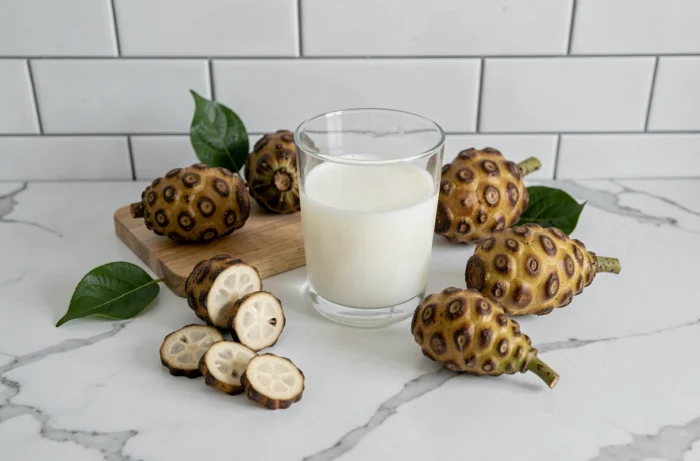
The first pitfall is the choice of fruit. A still green or yellowish noni will yield almost no juice and will be too astringent. The fruit must be translucent, almost white, and yield under slight pressure. A strong odor at this stage is normal.
The second often overlooked point is the container. For fermentation, only glass should be used. Plastic absorbs the organic acids from the noni and can release undesirable compounds over a two-month period. Metal should be avoided for the same reasons.
Filtration and preservation
After fermentation, the juice must be filtered through several layers of clean cloth to remove pulp residues. Insufficient filtering accelerates oxidation and results in juice that spoils within a few weeks, even when refrigerated.
- Store the filtered juice in dark glass bottles, filled to the maximum to limit residual air
- Keep in the refrigerator between 2 and 6 degrees, consume within weeks after opening
- Never pasteurize at high temperatures: heat degrades some of the sensitive compounds in noni
- Label each bottle with the filtration date to track the freshness of the batch
Benefits of noni juice: what medical sources highlight
Noni (Morinda citrifolia) has been consumed for centuries in Polynesia and Southeast Asia. It is attributed with properties related to vitality, strengthening natural defenses, and having an antioxidant effect. On this last point, the antioxidant activity is the best-documented benefit in the available scientific literature.
Some consumers report an energy boost after a few weeks of regular consumption. Feedback on this point varies, and there is no medical consensus attributing a stimulating effect to noni comparable to that of coffee or guarana. The perceived effect seems to be linked to the regularity of intake and the balanced diet that often accompanies it.
Dose and consumption routine
Most traditional guides suggest a small daily dose taken in the morning on an empty stomach. This is generally equivalent to a small glass. Starting with a reduced dose allows you to test digestive tolerance, as noni can be acidic and sometimes poorly tolerated at first.
Absorption seems better when the juice is consumed pure, without added sugar. If the taste is too difficult, mixing with vanilla or pineapple juice is preferable to adding refined sugar, which alters the product’s pH.

Health precautions often missing from online recipes
This is the blind spot of most content on homemade noni. Consumer organizations and medical-pharmaceutical sources report that noni can cause adverse effects in some individuals, particularly reversible but sometimes severe liver damage.
The Verbraucherzentrale (German consumer center) recommends avoiding noni in cases of kidney failure, liver damage, or diabetes. Updated medical summaries remind us that caution is also warranted in cases of hyperkalemia or treatment with hepatotoxic medications.
- Noni is not recommended during pregnancy and breastfeeding
- Its high potassium content poses problems for individuals with kidney disease
- Any regular consumption should be reported to your doctor, especially if you are undergoing medication treatment
These warnings do not undermine the interest in noni for a healthy person, but they condition how this product is integrated into one’s routine. A blood test before starting a long-term regimen remains the most reliable precaution.
Integrating noni juice into a balanced diet
Noni is not a substitute for a varied diet. Its value lies in the complementary supply of natural compounds that are hard to find elsewhere, combined with a regular routine. It is often associated with other organic products rich in antioxidants (berries, turmeric) to enhance the overall effect.
Daily consumption over several weeks yields better results than occasional high doses. Noni lends itself well to a regimen approach, with phases of intake and breaks, rather than continuous use without interruption.
Producing your homemade noni juice primarily requires diligence regarding the ripeness of the fruit, the choice of container, and preservation. The rest is patience, a reliable refrigerator, and the honesty to consult a healthcare professional if there is any doubt about tolerance.