
An engine oil does not degrade in a linear manner. The shearing of viscosity-improving polymers, thermal oxidation, and contamination by combustion by-products follow acceleration curves that depend on the actual thermal regime of the engine, not just the displayed mileage. Knowing when to replace the engine oil requires cross-referencing several technical indicators, rather than relying on a single warning light.
Oil change intervals and engine technology: what the computer doesn’t always tell you
Modern engines equipped with 100% synthetic long-life oils display manufacturer intervals of up to 18 to 24 months under stabilized road use. This leeway masks a technical reality that we regularly observe in the workshop.
Small turbo gasoline engines (downsizing) suffer from a phenomenon of fuel dilution in the oil, particularly during short urban trips. Unburned gasoline passes the rings and lowers the effective viscosity well before the theoretical deadline set by the maintenance computer. For these engines, we recommend tightening the oil change interval compared to the onboard recommendations.
The question of when to replace the engine oil arises differently depending on whether one is driving a plug-in hybrid with an extended range or a naturally aspirated diesel. In a range extender, the thermal engine kilometers are only counted when it is actually running, which can create a misleading gap between the total mileage on the odometer and the actual wear of the lubricant.

Particular case of PureTech and chain-driven engines
Some three-cylinder turbo engines, notoriously known for their reliability issues related to the timing system, require enhanced monitoring of the lubricant. Degraded oil accelerates the wear of the chain and tensioners. A shortened oil change interval directly protects the timing system on these sensitive blocks.
Visual and olfactory analysis of oil on the dipstick
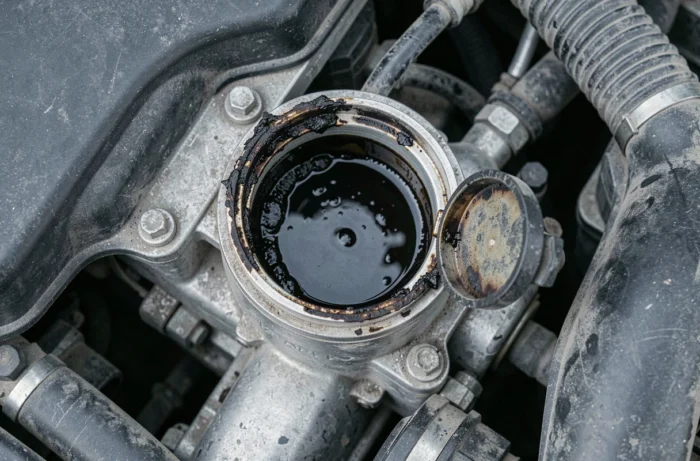
The color of the oil on the dipstick provides partial but usable information. New oil is amber and translucent. After a few hundred kilometers, it naturally darkens as it captures soot, especially in a diesel. This rapid darkening is normal and does not, by itself, justify an early oil change.
What should raise concern is the texture. Rub a drop of oil between your thumb and index finger. Oil at the end of its life loses its greasy and slippery feel. It becomes grainy, a sign that the detergent and dispersant additives are exhausted and that metallic particles are circulating in the lubrication circuit.
- Milky coffee color or whitish emulsion on the filler cap: presence of water or coolant in the oil, requiring immediate diagnosis of the head gasket.
- Strong fuel odor on the dipstick: dilution by gasoline or diesel, compromised viscosity, oil change to be performed without waiting for the scheduled deadline.
- Level dropping between two checks without visible ground leaks: internal consumption by the rings or valve guides, to be monitored by noting successive top-ups.
Oil that smells burnt indicates a local overheating in the block. This symptom often precedes the appearance of bluish smoke from the exhaust, indicating oil combustion in the chambers.
Oil pressure and engine warning light: technical reading of alerts
The oil pressure warning light (the oil can) does not simply indicate a low level. It indicates that the pressure in the lubrication circuit has fallen below the critical threshold. At this stage, the crankshaft bearings and bushings are already turning without sufficient oil film.
We often observe confusion between the level warning light and the pressure warning light. On most recent vehicles, these two alerts are distinct. The pressure warning light requires immediate engine shutdown, not a detour to the gas station for a simple top-up.
Mechanical noises associated with insufficient lubrication
A metallic ticking sound when cold at startup, which disappears after a few seconds, indicates that the time to build pressure in the oil circuit is too long. Possible causes are multiple: viscosity unsuitable for the ambient temperature, clogged oil filter, or worn oil pump.
Dull knocking sounds under load (hard acceleration, climbing a hill) indicate metal-to-metal contact at the connecting rods. This noise is a last resort signal. The oil has lost its ability to maintain a hydrodynamic film between moving surfaces.
Oil filter and filtration quality: the often-neglected link
Replacing the oil without changing the filter is like pouring new lubricant into a contaminated circuit. The filter accumulates all the metallic particles, combustion residues, and oxidation sludge retained over the kilometers.
A saturated filter allows oil to circulate through its bypass valve without any filtration. The flow is maintained to preserve pressure, but abrasive particles circulate freely and accelerate the wear of the rubbing surfaces.
- Prefer an OEM or equivalent quality oil filter, with a filtering medium whose retention capacity meets the manufacturer’s specifications.
- On dry sump engines or turbo engines with plain bearings, the filtration fineness has a direct impact on the longevity of the turbocharger.
- Check the condition of the filter’s O-ring during replacement: a crushed or mispositioned ring causes a silent pressure leak.
Synthetic oil and extended intervals: a false sense of security
Long-life oils do indeed maintain viscosity better at high temperatures. However, their additive package (antioxidants, detergents, ZDDP anti-wear) depletes at the same rate as in a conventional oil subjected to the same thermal constraints. The extended interval is based on ideal usage conditions that frequent urban driving rarely meets.
The best indicator remains the comparison between the type of trips actually made and the manufacturer’s recommendations for severe use. The majority of urban drivers fall into the “severe use” category without realizing it, which significantly reduces the oil change interval compared to the nominal value displayed.
Monitoring the condition of your engine oil does not require special skills or expensive equipment. A dipstick, a clean cloth, and regular attention to dashboard alerts are enough to avoid the most costly damage to a powertrain.