
The drawer opens at 4 PM, hunger rises, and we grab whatever is lying around. Stuffed biscuits, chocolate bars, a handful of sweet cereals: the default snack is rarely the one that sustains. Choosing healthy snacks is less about willpower and more about method, concrete criteria, and preparation in advance.
Reading a snack label without getting trapped
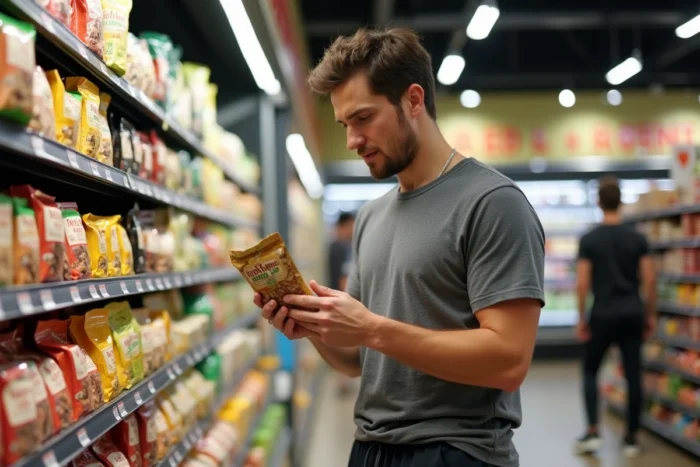
The first instinct is to turn the package over. The front of a product makes promises (“high in fiber”, “source of protein”), but the ingredient list remains the only reliable indicator. The shorter it is, the closer we are to a minimally processed food.
We look for three things. First, the position of sugar: if it appears in the first three ingredients, in any form (glucose syrup, dextrose, cane sugar), the product is a disguised dessert. Next, sodium, often high in crackers and snack mixes marketed as “healthy.” Finally, the length of the list: beyond ten components, we enter the territory of ultra-processed foods.
To find tips for choosing a healthy snack on Madame Gertrude, this reading grid already helps eliminate a good portion of the aisle.
One point where opinions vary: some cereal bars display a correct Nutri-Score while containing a lot of added sugars. The score aggregates several criteria, and a good fiber intake can offset excess sugar in the calculation. Therefore, we cannot rely solely on the score.
Creating a balanced snack at home
The most reliable snacks are those we prepare ourselves because we control every ingredient. The basic principle can be summed up in a simple rule: combine a source of fiber and a source of protein to slow digestion and avoid the blood sugar spike followed by a crash.
Concrete combinations that work daily
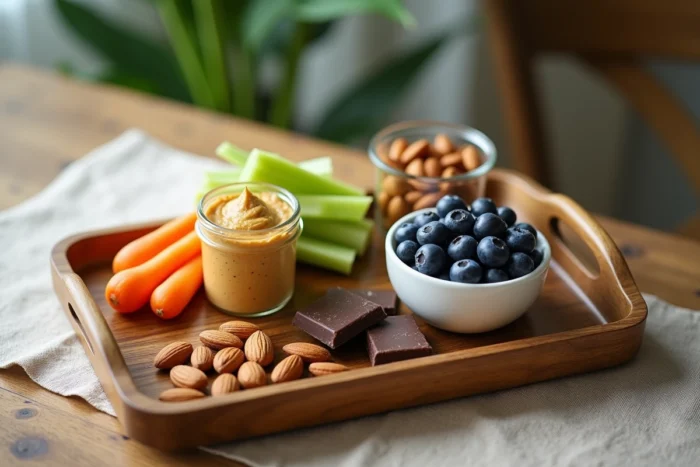
- Raw vegetables (carrot sticks, cucumber, radishes) with hummus or fresh cheese: the fiber from the vegetable and the protein from the hummus form a satisfying duo, ready in two minutes
- Fresh seasonal fruits (apple, pear, banana) with a handful of nuts (almonds, walnuts): the fruit provides quick carbohydrates, while the nuts provide fats and proteins that prolong satiety
- Plain yogurt (without added sugar) with oats and a few berries: it’s a complete snack that covers fiber, protein, and vitamins
- Whole grain rice cakes with a bit of unsweetened peanut butter: quick, portable, and sufficiently caloric to last until the next meal
These combinations require neither elaborate recipes nor expensive ingredients. The idea is not to cook but to assemble.
Preparing snacks for the week in one session
Cutting and portioning on Sunday evening changes the game. We wash the vegetables, cut the sticks, and distribute the nuts into small containers. The action may seem trivial, but it prevents a trip to the vending machine on Wednesday at 3 PM.
Whole fruits keep well all week without preparation. For cut fruits, a drizzle of lemon juice limits oxidation. Portions of nuts can easily be kept in a reusable bag at the bottom of the work bag.
Healthy snacks at the office and on the go
The main constraint outside the home is the lack of refrigeration and limited time. We’re not going to pull out a blender in an open space. The portable snack must be stable at room temperature and not require utensils.
Dried fruits and nuts remain the best allies on the go. Dried apricots, figs, dates (in moderation, as their caloric density is high), mixed with almonds or hazelnuts, make a compact snack. We avoid store-bought mixes that add salt, sugar, or chocolate coatings.
For those with access to a fridge at work, homemade fruit salads, pre-cut raw vegetables, or a small pot of cottage cheese are solid choices. The advantage of bringing your snack on Monday morning for two or three days is that it eliminates the daily decision, which often leads straight to the vending machine.
Frequency and quantity of snacks throughout the day
We often hear that we should eat “five small meals a day.” This recommendation is not universal. A snack is only useful if it addresses real hunger, not boredom or a habit of snacking.
A good guideline: if lunch is at noon and dinner at 8 PM, a snack around 4 PM fills an eight-hour gap. This is a real physiological need. On the other hand, snacking an hour after a full meal is more about habit than hunger.
In terms of quantity, a snack represents a moderate intake. We’re talking about a portion of fruit, a small handful of nuts, or a yogurt, not a second meal. A common mistake is to combine several healthy foods without moderation: a banana plus hummus plus nuts plus yogurt can end up representing as many calories as a real meal.
Snacks for children: adapting the criteria without complicating
Children have proportionally higher energy needs, and their taste attention span is narrower. What works: visually appealing snacks, easy to eat with fingers, and without too many mixed components.
- Colorful vegetable sticks (bell pepper, carrot, cucumber) with a lightly seasoned yogurt dip
- Slices of apple with a drizzle of peanut butter
- Mini-portions of cheese paired with some dried fruits
A child who participates in preparation is more accepting of the snack. Allowing them to choose between two predefined options (apple or banana, hummus or cheese) gives a sense of control without opening the door to all-sweet options.
The national school nutrition program in Canada illustrates this logic on a large scale: healthy snacks have become a public policy issue, aiming to provide up to 400,000 additional healthy meals per year according to Agriculture and Agri-Food Canada. Individual choices at home align with this direction, but we maintain control over quality.
A well-chosen snack meets three criteria: few processed ingredients, a fiber-protein combination, and advance preparation. The rest is about adjusting to the rhythm of each day and the constraints of the moment.