
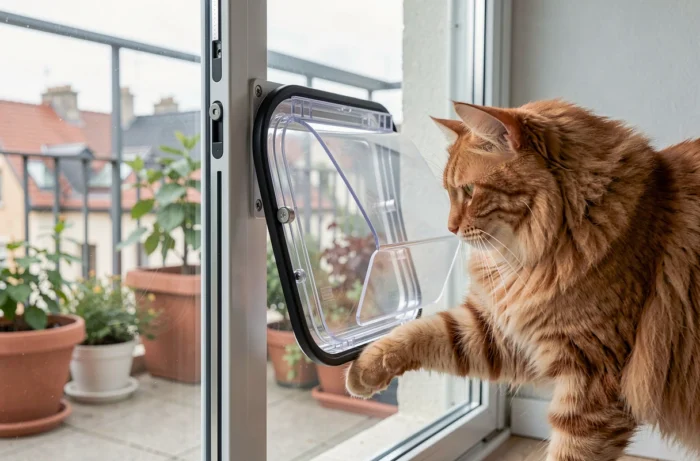
A removable cat flap for a sliding door is a rigid panel that slides into the track of a sliding bay and includes a flap for the cat to pass through, without drilling or cutting the glazing. The panel can be removed in a few seconds, allowing the property to be returned to its original state at the end of the lease.
Dimensional compatibility: what determines the choice of panel
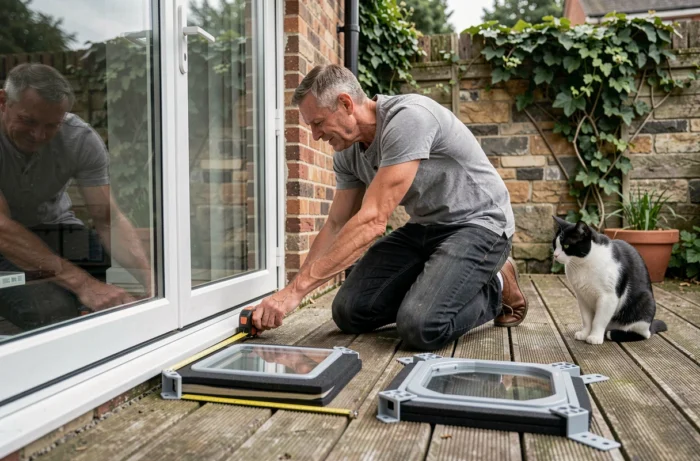
The first instinct before any purchase is to measure three dimensions on the sliding door: the clear height between the threshold and the top of the track, the width of the track (the space in which the panel will slide), and the depth of the frame. A difference of a few millimeters in any of these dimensions is enough to make the panel unstable or impossible to insert.
Models labeled as “universal” rarely cover all configurations. Some manufacturers offer extensions or telescopic sections to adapt to varying heights, but the width of the track remains a blocking factor. On a pocket door, the track is often narrower than on a classic sliding door: check this point before ordering.
To compare the available solutions, consulting a removable panel with an integrated cat flap on Oh Brico helps identify formats compatible with the most common rental configurations.
Sealing and insulation of a removable cat flap on a sliding door
The question arises systematically: does a removable panel allow air and water to pass through as much as a cat flap cut into a door? The answer depends on two distinct areas: the junction between the panel and the frame of the bay, and the flap itself.
Panel-track junction: the weak point to address
The panel rests in the track without permanent fixation. The sealing depends on the peripheral seals, usually made of foam or brush, pressed against the frame. Recent models incorporate magnetic seals or compression strips that improve wind resistance.
A poorly positioned panel vibrates under gusts and creates a linear thermal bridge along its entire height. Securing the panel with the track locking screw (present on most sliding bays) eliminates this lateral play without drilling anything.
Flap: magnetic closure or mechanical locking
The single flap, held by a magnet, is sufficient for summer use. In winter, drafts pass through the flap as soon as the cat pushes it. Double flap or reinforced magnetic closure flaps reduce these infiltrations, but do not eliminate them entirely.
Some panels offer a removable weather flap that clips onto the flap when the cat stays inside. This rigid flap blocks the passage of air and can be removed in seconds when the animal needs to go out.
Panel security in rentals: locking and intrusions
Installing a panel in the track of a bay creates a potential opening for an intruder if the device is not locked. Two mechanisms exist on the market:
- The track locking screw of the bay, which prevents the panel from sliding laterally and also locks the main opening of the sliding door
- The lock integrated into the panel itself, often a latch or key lock, which secures the panel to the upper frame of the track
- Panels with cylinder locks, rarer, which offer a level of resistance comparable to a standard window lock
Without locking, the panel can be lifted and removed from the outside. This point should be checked before purchase, especially on the ground floor or with direct access from a shared garden.
The flap itself can allow an arm to pass through. Models with electronic chips only open to the passage of the identified cat, which also prevents the entry of stray animals. For human anti-intrusion security, it is the locking of the panel in the track that matters, not the type of flap.
Tool-free installation and reversibility: what “tool-free” means in practice
Recent comparisons highlight “tool-free” solutions designed for renters. In practice, installation involves opening the sliding bay, sliding the panel into the free track, and then closing the opening against the panel. No drilling, no glue, no permanent silicone seal.
The actual reversibility depends on what you add to the basic installation. If you stick an adhesive weatherstrip on the frame to improve sealing, removal may leave glue residues. Prefer compression seals or repositionable adhesive magnetic strips, which peel off without leaving marks on a PVC or aluminum frame.
The panel itself does not alter the carpentry. Returning the property only requires the removal of the panel, without the need for a glazier or carpenter. This point significantly simplifies the end of the lease compared to a flap cut into the glazing, which requires the complete replacement of the double glazing.
One last often-overlooked detail: store the panel flat to avoid warping, especially if it is made of extruded PVC. A warped panel will no longer slide in the track upon reassembly.