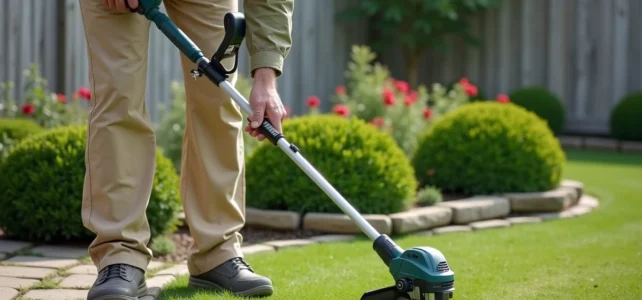
Choosing the power of a cordless electric trimmer comes down to a sizing question: what cutting energy for what type of vegetation and what area? The battery voltage, amp-hour capacity, and cutting width form a trio of measurable data that helps to decide between the available ranges.
Battery Voltage and Capacity: The Table That Summarizes the Differences
The nominal battery voltage (expressed in volts) directly determines the motor torque and thus the ability to cut through more or less dense grasses. The capacity (in Ah) conditions the autonomy per charge. Cross-referencing these two parameters provides a quick overview of the covered uses.
| Battery Voltage | Current Capacity | Type of Vegetation | Suitable Area |
|---|---|---|---|
| 18 V | 2 to 2.5 Ah | Fine grass, low grass | Small city garden |
| 20-24 V | 2.5 to 4 Ah | Medium-high grass, regular mowing reflections | Medium garden, mixed borders |
| 36 V and above | 4 Ah and beyond | Tall grasses, tough grasses | Large area, semi-wild zones |
A device with 18 V is suitable for finishing around flower beds and paths on lawns maintained weekly. To understand how to determine the power of a cordless electric trimmer, it is important to keep in mind that as soon as the vegetation exceeds ankle height or the terrain has slopes, the minimum voltage to consider increases.
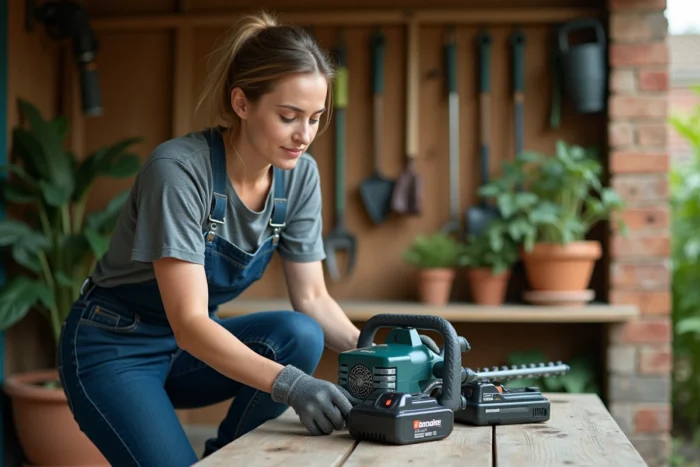
On the other hand, increasing voltage without a real need makes the device heavier and reduces maneuverability. A 36 V trimmer weighs significantly more than an 18 V model, which matters during a finishing session that lasts more than twenty minutes.
Cutting Width and Nylon Line: Two Parameters Related to Actual Power
Motor power is not only reflected on the label in watts or volts. It is concretely expressed by the cutting width, which is the diameter of the circle swept by the nylon line. The larger the width, the more effort the motor must exert to maintain a sufficient rotational speed.
Entry-level models offer a reduced cutting width, sufficient for edging a wall or clearing the base of a tree. More powerful devices expand this area and accept a thicker nylon line, capable of withstanding tougher stems.
- A thin nylon line (about 1.4 to 1.6 mm in diameter) is sufficient for soft grass but breaks quickly on dry or woody grasses.
- A thicker line requires a motor capable of spinning it fast enough to cut cleanly, which excludes small 18 V batteries.
- The line diameter is an indirect indicator of useful power: if the manufacturer provides a thick line, the motor is sized accordingly.
A common pitfall is replacing the original line with a thicker one in the belief that it will improve cutting. The motor then struggles to reach optimal speed, the cut becomes uneven, and the battery drains faster.
Wireless Battery and Regulations: What Changes the Power Calculation
Battery-powered devices are experiencing the fastest growth in the market for outdoor motorized equipment, according to the 2026 report from Fortune Business Insights. This trend is explained by the tightening of regulations on emissions and noise from gas engines in several countries.
For the individual, this trend has a direct consequence: the power available on battery models is increasing thanks to higher voltages and more capacious cells. The historical compromise between autonomy and cutting capacity is diminishing year by year.
Where an older generation cordless trimmer struggled with tall grasses, current 36 V ranges compete with wired models during reasonable work sessions. The question is no longer whether the battery “suffices,” but how to calibrate the voltage and capacity to the actual need.
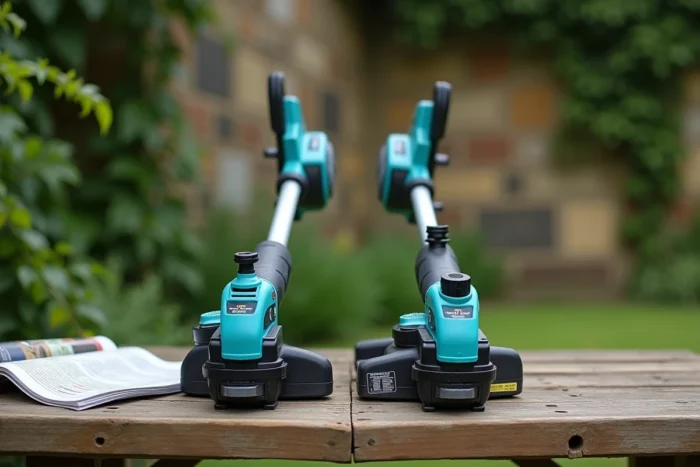
Adapting Power to the Garden Profile: Three Concrete Cases
Rather than reasoning in abstract numbers, here are three typical configurations and the sizing that corresponds to them.
Urban Garden with Regular Lawn
Edging along a terrace, fence bases, around flower beds. The grass is mowed weekly. An 18 V device with a thin diameter line meets this need without excess weight or cost. The autonomy of a 2 Ah battery is more than sufficient for this perimeter.
Suburban Garden with Varied Areas
Classic lawn, but also a slope, hedge borders, and a few less accessible corners. The vegetation is not always low. A model with 20-24 V and a 4 Ah battery provides enough torque to handle varying conditions without running out of charge before finishing the round.
Large Area with Seasonal Tall Grasses
Ditches, overgrown vegetable garden edges, grasses going to seed. The cutting goes beyond simple finishing. A 36 V becomes relevant, possibly with a harness to distribute the weight. At this point, the boundary with the brush cutter gets closer: if the vegetation is woody, the trimmer reaches its limits regardless of the voltage.
Wireless Trimmer: Often Underestimated Criteria
Beyond raw power, two elements influence the user experience as much as the number of volts.
- The battery compatibility with other tools from the same brand. Some manufacturers offer a single platform (the same battery for the hedge trimmer, blower, mower). This directs the choice towards an ecosystem rather than an isolated device.
- The line advancement system (automatic, semi-automatic, or manual) has a direct impact on comfort. A poorly adapted system forces frequent stops, which negates the power gain on paper.
- The total weight in working order (device plus battery) affects fatigue. An unnecessary power surplus translates into extra kilos with each pass.
The proper sizing of a cordless electric trimmer relies on the match between battery voltage, type of vegetation, and area to be maintained. A device that is too powerful is heavy and costly without real benefit, while an undersized device strains the motor and prematurely wears out the battery. Starting from the profile of your garden remains the most reliable filter before comparing technical specifications.