
Starting a Stihl gasoline chainsaw requires neither special strength nor mechanical talent. Success depends on the precise order of actions and understanding the role of each control. When the engine refuses to start or floods its spark plugs, the cause is almost always found in a skipped or reversed step. This guide analyzes the actual friction points, compares the sequences based on the type of engine, and details the measurable errors that separate a clean start from a failure.
Cold or hot starting a Stihl chainsaw: what changes concretely
The distinction between cold start and hot start determines the position of the choke and the number of pulls needed. Confusing the two situations is the primary cause of engine flooding.
| Parameter | Cold Start | Hot Start |
|---|---|---|
| Choke position (flap) | Closed (fully pulled) | Open (pushed, run position) |
| Priming pump | Press several times until fuel is visible | Unnecessary if the stop was recent |
| Decompression valve | Press before each pull | Press before each pull |
| Typical number of pulls | More (varies with ambient temperature) | Generally one to two pulls |
| Main risk | Flooding if the choke remains closed too long | Stalling if the choke is pulled reflexively |
The classic trap: after hearing the first “pop” of the cold engine, some users continue to pull the cord without pushing the choke back to the intermediate position. The engine then draws in excess fuel and floods the spark plug.
To delve deeper into starting a Stihl chainsaw based on your model, the procedure varies slightly between machines equipped with the M-Tronic system and those with manual carburetor adjustment.
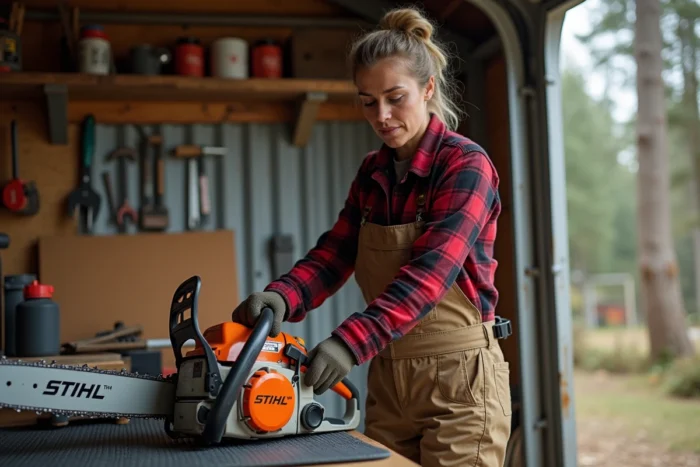
Stihl chainsaw with or without M-Tronic: comparison of starting sequences
The M-Tronic system, present on some Stihl models (identifiable by the suffix “C-M” in the reference), electronically manages the air-fuel mixture. The starting sequence is simplified, but not identical to that of a classic model.
Model without M-Tronic (manual adjustment)
- Engage the chain brake by pushing the hand guard forward, then remove the chain guard if it is in place
- Press the decompression valve (if the model has one), press the priming pump until fuel circulates, then pull the choke in the closed position
- Pull the starting cord until the first engine “pop,” push the choke back to the intermediate position, then pull again until the engine starts
- Briefly accelerate to disengage the starting speed, then release the chain brake before starting work
Model with M-Tronic
The electronics eliminate the manual adjustment of the carburetor. The choke has only two positions (run and stop) instead of three. The M-Tronic automatically adjusts the mixture according to the temperature, which reduces the number of pulls needed for a cold start.
However, the decompression valve and chain brake function identically on both types. A common mistake is to believe that M-Tronic eliminates the need to use the priming pump: this is not the case during the first start or after prolonged storage.
Flooded engine on a Stihl chainsaw: diagnosis and recovery
A flooded engine can be recognized by two signs: a strong smell of fuel at the air filter and an abnormally low resistance when pulling the cord. The spark plug, when removed, appears wet with fuel mixture.
The recovery procedure follows a precise order. Place the choke in the open position (run). Remove the spark plug and dry it, or replace it if it is fouled. Pull the cord several times with the spark plug removed to expel excess fuel from the cylinder. Reinstall the spark plug, press the decompression valve, and pull without activating the choke.
Never re-prime a pump on an already flooded engine. Adding fuel to a saturated cylinder worsens the problem and can damage the rings in the long term.

Fuel and chain oil errors that prevent starting
The fuel for Stihl gasoline chainsaws is a two-stroke gas-oil mixture. Using pure gasoline destroys the engine. Using a poorly mixed or aged mixture causes starting failures or erratic operation.
Here are some points to check before suspecting a mechanical failure:
- The mixture must be recent: fuel stored for more than a few weeks loses its properties, especially if the canister has been left open or exposed to heat
- The chain oil reservoir must be full: an unlubricated chain blocks at startup and damages the guide
- The air filter must be clean: a clogged filter alters the air-fuel ratio and complicates initial combustion
- The spark plug should appear dry and slightly brown: a black or wet spark plug indicates a mixture problem or flooding
Perplexity research highlights an interesting fact: many users are now switching from battery chainsaws to gasoline ones. This transition creates specific errors, as battery machines do not require fuel mixture, priming pump, or choke. The reflex of “press and pull” does not work on a gasoline engine.
Usage restrictions and starting time: a often overlooked parameter
Beyond pure technique, the timing of starting a gasoline chainsaw can pose problems. Departmental regulations now govern the use of gasoline-powered tools during periods of high fire risk. Fire services publish daily risk levels, and some local regulations temporarily prohibit chainsaw work during peak danger times.
Checking the forest fire risk level in your department before starting your Stihl in wooded areas is not an excess of caution. Violating these regulations exposes you to penalties, and a gasoline chainsaw produces potential sparks at the exhaust.
A successful start of a Stihl gasoline chainsaw boils down to three verifiable elements: fresh fuel properly mixed, strict adherence to the choke-priming-decompression order suitable for the engine temperature, and a chain brake engaged before the first pull. Everything else pertains to diagnosis, not the normal procedure.