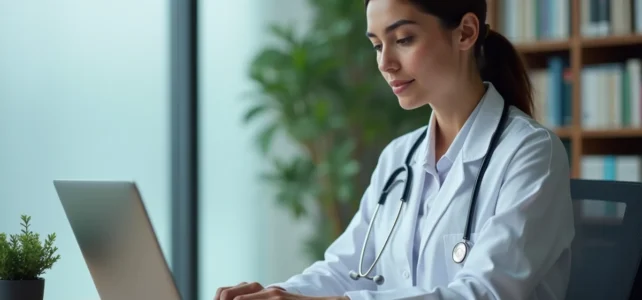
A general practitioner looking for an update on drug interactions between two consultations does not have twenty minutes to spare. A freelance nurse wanting to check a vaccination protocol from their vehicle needs a reliable answer in a few seconds, not a public search engine flooded with unverified results. It is this constraint of time and reliability that currently shapes access to digital resources for healthcare professionals.
AI Clinical Search Engines Reserved for Healthcare Professionals
Public search engines pose a recurring problem in clinical practice: sorting between validated sources and approximate content sometimes takes longer than the consultation itself. Tools like Vera Health change the game by providing evidence summaries from tens of millions of articles and recommendations, with systematic citations.
Vera Health is completely free for all licensed healthcare professionals and students. The platform is designed to integrate into the clinical workflow, meaning that one can launch a query between two patients without leaving their workstation.
This type of tool does not replace clinical judgment, but it significantly shortens the time to access evidence-based data. For French-speaking practitioners, this is a concrete lever: the language barrier that made certain Anglo-Saxon databases less usable on a daily basis is gradually fading. One can also find professional information on Optisanté to complement their research with content structured by specialty.
Access to DMP and My Health Space via the RPPS Portal
Consulting a patient’s shared medical record from one’s office or during a home visit first requires proper identification. The RPPS+ portal and Pro Santé Connect centralize this identification for professionals registered in the shared directory of healthcare professionals.
What RPPS+ Changes Daily
Unified access via RPPS+ avoids juggling multiple identifiers depending on the services. A single identifier-authentication pair opens access to the DMP, My Health Space, and tele-services. Since the summer of 2022, almost all social security beneficiaries have a My Health Space profile, unless explicitly opposed.
In practice, this means that one can send a prescription or a report directly into the patient’s space, consult their recent lab results, and exchange messages securely. Traceability is enhanced: every access to the record is logged, which protects both the patient and the practitioner.
Technical Prerequisites to Verify
- Have a valid CPS card or an e-CPS identification method on a smartphone, activated via the dedicated application
- Use practice management software compatible with My Health Space services (the list can be consulted on the website of the Health Digital Agency)
- Check that the registration with RPPS is up to date, especially after a change of practice location or specialty
Feedback varies on the fluidity of the experience depending on software publishers, but the technical foundation is now stable for the majority of configurations.
Free E-Learning Training in Digital Health
Mastering the tools is not enough if one does not understand the regulatory framework and best practices surrounding them. The EHESP (School of Advanced Public Health Studies) provides several online training platforms in open access, covering digital health, exceptional health situations, prevention, and addictive behaviors.
These modules are designed for active professionals: short formats, updated content, accessible without paid registration. The Health Digital Agency also offers a training pathway dedicated to e-health, accessible from its portal.

Choosing a Training Suitable for One’s Practice
A community pharmacist and a hospital doctor do not have the same needs regarding digital health. The EHESP modules allow targeting a specific topic without following a complete curriculum. For a freelancer starting with teleconsultation, a module on patient data security will be more useful than a general course on digital transformation.
The time invested in targeted training is recovered within the first weeks of using a new tool. This is particularly true for secure messaging and document sharing functions in My Health Space, whose use remains underutilized due to a lack of technical mastery.
Medical Collaboration Platforms and Tele-expertise
Tele-expertise allows a physician to seek the opinion of a specialist colleague without the patient having to travel. Platforms like Omnidoc structure these exchanges on a single channel, compatible with the requirements for traceability and confidentiality of medical data.
- The request for an opinion is formalized with the patient’s record, necessary images or results, and transmitted to the specialist via the platform
- The specialist responds within a defined timeframe, with a structured opinion that can be integrated into the patient record
- The entire exchange is archived and accessible for follow-up, preventing information loss between correspondents
Tele-expertise reduces the time to access specialized advice, a critical point in areas with low medical density. For structures coordinating multiple professionals (multi-professional health houses, CPTS), these tools become an organizational foundation.
Interoperability remains the main selection criterion: a platform that does not communicate with the practice management software generates more friction than it removes. Before adopting a tool, one verifies its compatibility with core services (DMP, secure health messaging) and with their own information system.
Access to digital resources for healthcare professionals is no longer limited to the DMP or traditional databases. Between AI clinical search engines, free training from EHESP, and tele-expertise platforms, the landscape has significantly expanded. The filter to apply remains the same: reliability of sources, technical compatibility, and real-time time savings at the point of care.