
The eye of Saint Lucia is a calcareous operculum produced by the Bolma rugosa, a Mediterranean gastropod mollusk from the Turbinidae family. Collected from the beaches of Corsica or the Mediterranean, this operculum with its characteristic spiral attracts both collectors and handmade jewelry enthusiasts. Its calcareous nature requires cleaning and mounting precautions that general guides rarely detail, especially when the operculum is intended to be set in a metal mount.
Calcareous Fragility of the Eye of Saint Lucia: What the Composition Changes for Cleaning
Most tutorials treat the eye of Saint Lucia like a classic semi-precious stone. The problem is that this operculum is softer than fine stones used in jewelry. Its calcareous matrix reacts to acids, even weak ones, and to chlorinated agents.
Specifically, white vinegar, lemon, household cleaners, and bleach should be avoided. Pool chlorine also attacks the surface and can cause irreversible whitening of the colored spiral. Perfumes and colognes applied near a necklace or bracelet dull the pearly luster within weeks.
To learn how to make jewelry with an eye of Saint Lucia, you must first master this cleaning step, as a poorly prepared operculum will lose its shine once mounted.
The safest method remains a soak in lukewarm water with a mild soap (Marseille soap, diluted black soap), followed by a light brushing with a soft toothbrush. The raw operculum collected on the beach may carry stubborn organic residues. In this case, a prolonged soak of several hours is enough to soften them without resorting to an acidic product.

Polishing the Raw Operculum: Grit, Technique, and Limits of Handmade
An eye of Saint Lucia found on the sand often has a rough, whitish face, sometimes encrusted with marine limestone. Polishing transforms this dull face into a smooth surface, ready to be mounted as jewelry.
Progression of Sanding Grit
The principle is to start with a medium grit to remove roughness, then gradually move to a very fine grit to achieve a satin shine. Water-resistant sandpaper works well because it limits heating and calcareous dust.
- Start with a medium grit to remove marine deposits and flatten the irregularities of the flat face
- Move to a fine grit to smooth the surface without scratching the visible spiral on the convex side
- Finish with a very fine grit, using regular circular motions, to bring out the pearly shine
- Rinse the operculum between each step to prevent residues from the previous grit from scratching the surface
The spiral side (the convex face, which will be visible on the jewelry) requires more delicacy. A too forceful gesture or an overly aggressive grit can erase the color nuances. Always polish in the direction of the spiral, never across.
What Manual Polishing Cannot Correct
A cracked or heavily eroded operculum will not regain its integrity after sanding. If the spiral is barely visible or if chips are missing from the edges, it is better to look for another specimen. Feedback from Corsican artisans varies on the usefulness of applying a thin layer of mineral oil after polishing: some see it as a temporary shine gain, while others believe it yellows over time.
Mounting and Setting: Adapting the Jewelry to a Calcareous Operculum
It is at the mounting stage that many projects go wrong. The eye of Saint Lucia is not drilled like a bead, and its irregular shape complicates classic setting.
Three options frequently appear in handmade creations:
- Silver claw setting, which holds the operculum without gluing it, allowing for removal for maintenance
- Gluing onto a flat mount (bail, ring support), simpler but definitive and sensitive to humidity
- Weaving with thread or cord (macramé, braided nylon), suitable for pendants and bracelets, which avoids any chemical contact with the operculum
The choice of glue for glued mounts deserves attention. Cyanoacrylate glues can whiten the edge of the operculum if they overflow. A two-component epoxy glue, applied in a thin layer, offers better hold without altering the visible surface.
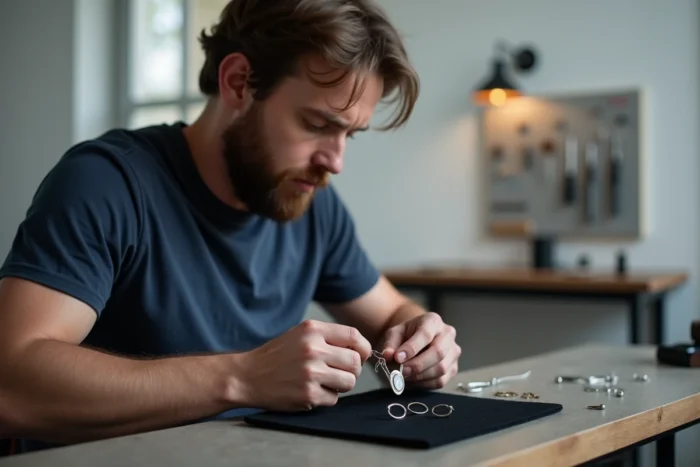
Protecting the Mount During Cleaning
A jewelry piece mounted on metal (silver, gold-plated steel) should not be cleaned like a raw operculum. Prolonged immersion in soapy water can infiltrate the crevices between the mount and the operculum, promoting metal oxidation or glue detachment. A slightly damp microfiber cloth, wiped over the surface of the eye without wetting the mount, remains the safest method for regular maintenance.
Daily Maintenance of an Eye of Saint Lucia Jewelry
Wearing jewelry with an eye of Saint Lucia daily requires some adjustments. The most common recommendation from specialized jewelers is to remove the jewelry before showering, swimming, and cleaning. Repeated contact with chlorinated water, soaps, or detergents shortens the lifespan of the pearly shine.
Apply perfume before putting on the jewelry, never after. Store the necklace, bracelet, or ring in a soft pouch, away from moisture and friction with other metal pieces.
A well-polished and properly mounted operculum retains its shine for years. The spiral may even gain depth of hue over time, provided the surface has not been damaged by unsuitable products. Limestone is unforgiving of cleaning mistakes, but greatly rewards minimal and regular maintenance.