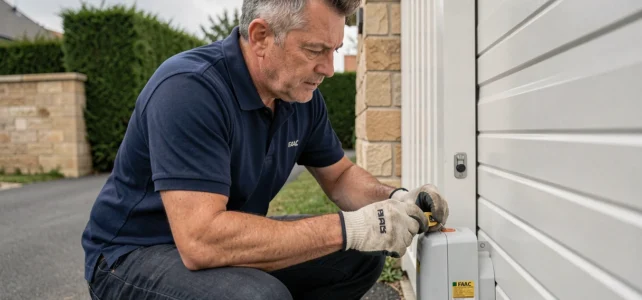
Your Faac gate remains immobile, the remote control does not trigger anything, and you are stuck in front of your house. Before contacting a technician, several simple manipulations can allow you to regain manual control of the gate. However, you need to know the correct sequence, as a wrong manipulation can damage the internal mechanism of the motor.
Faac Unlocking Lever: The Sequence Most Guides Forget
All Faac automation systems include a manual unlocking device provided by the manufacturer. This system allows you to disengage the motor to slide or pivot the gate manually. The principle is simple, but the exact sequence matters.
On recent sliding models like the Faac C720 and C721, the manufacturer’s manual emphasizes a specific point. The unlocking lever must first be turned in the direction indicated on the casing, then completely lowered to the mechanical stop. Only after this double manipulation can the gate be moved by hand without forcing the reducer.
If you skip the step of fully lowering, the pinion remains partially engaged in the rack. The result: you force a mechanism that is still locked, which risks damaging the internal gears. To open a Faac gate in case of a breakdown without causing further damage, this sequence of rotation followed by lowering is the only one to follow.
On swing models equipped with actuators (series 391, 392, or similar), unlocking typically involves a triangular or Allen key inserted into a lock on the motor casing. A quarter turn is enough to release the actuator arm. The leaf can then be pushed by hand.
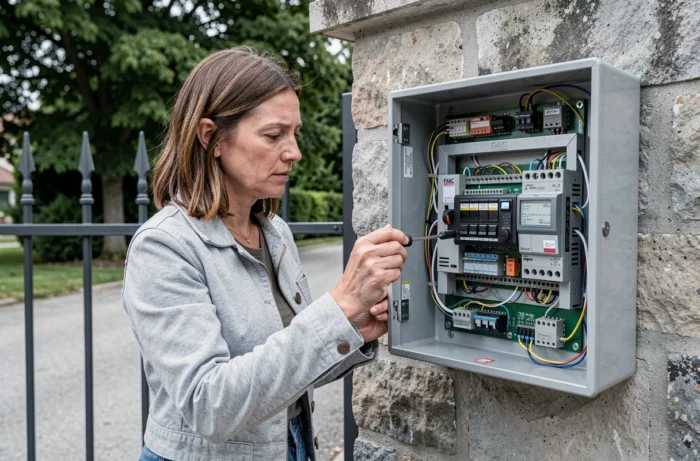
Faac Gate Stuck After Power Outage: Understanding Automatic Re-locking
You experienced a power outage, the power returns, but the gate remains stuck. This scenario generates many calls to installers, although it can be easily explained.
A manually unlocked gate does not re-lock by itself when electricity returns. The lever (or key) must be returned to the motorized operating position. Without this manipulation, the motor runs idle since the pinion is still disengaged.
Here’s what to do after the power returns:
- Bring the unlocking lever back to the high position (or turn the key in the opposite direction) until you feel the engagement notch.
- Test a complete open-close cycle with the remote control to verify that the motor is indeed driving the gate.
- If the gate starts and then stops halfway, initiate a recalibration procedure (described in the model’s manual) so that the electronic board relearns the end positions.
This recalibration is often necessary after a prolonged power outage. The electronic board loses the memory of the gate’s extreme positions and activates a safety feature that stops the movement.
Faac Remote Control Not Responding: Checks Before Replacing It
Before ordering a new remote control, a few quick checks can eliminate the most common causes.
Change the battery first, even if the remote control seems to work. A weak battery can still light up the remote control’s LED without emitting a strong enough signal to reach the receiver. This false contact can be misleading.
If the new battery does not change anything, get closer to the motor and press the button from less than two meters away. On some Faac models, a small audible “click” at the receiver confirms that the signal is indeed arriving. If you hear this click but the gate does not move, the problem lies with the electronic board or the motor, not the remote control.
When no click occurs, the remote control may have lost its pairing. The reprogramming procedure varies by model (XT2, XT4, or others), but the principle remains the same:
- Access the radio receiver in the control box.
- Press the learning button on the receiver (often a push button identified in the manual).
- In the seconds that follow, press the button on the remote control you wish to program.
- A light or sound signal confirms the registration.

Anticipating Failure: Test the Unlocking Procedure Before You Need It
The day your gate breaks down is not the right time to discover where the unlocking lock is or to search for the triangular key in a forgotten drawer.
Test the manual unlocking procedure at least once a year. Cut the power at the electrical panel, unlock the motor with the key or lever, move the gate by hand, then re-lock and restart a motorized cycle. This manipulation takes a few minutes and will save you unnecessary stress on the day.
Keep the unlocking key in an accessible location from the outside, or keep a spare with a trusted neighbor. On recent Faac models, the unlocking key is a standard part that can be ordered from the manufacturer or a specialized dealer if lost.
One last often-overlooked point: if your gate is equipped with photocells, periodically check their alignment. A slightly misaligned sensor (shock, vibration, weather) can block any opening command while the motor and board are functioning perfectly. A simple cleaning of the lens with a dry cloth sometimes resolves a problem that seemed complex.