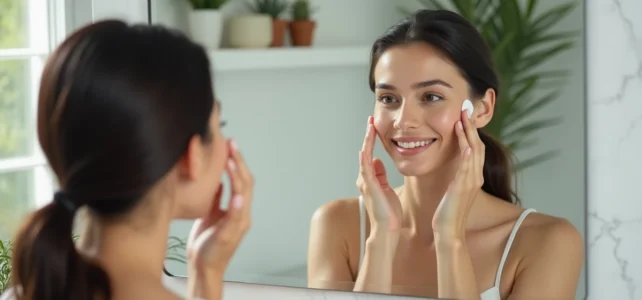
The skin barrier dictates the quality of the complexion long before the choice of a serum or cream. An epidermis with an altered hydrolipidic film will not respond to cosmetic actives, no matter how noble they may be. Enhancing your skin naturally involves a precise understanding of what is happening on the surface of the epidermis, not the accumulation of products.
Skin barrier and natural care: the factor that most routines ignore
The stratum corneum functions like a mortar of intercellular lipids (ceramides, cholesterol, fatty acids) that retains water and filters aggressions. When this mortar is weakened by overly stripping cleansers, too frequent exfoliations, or a layering of irritating actives, the skin enters a subtle inflammatory cycle: diffuse redness, paradoxical shine on dehydrated skin, increased sensitivity.
We observe that the majority of reactive skin lacks not actives but cosmetic rest. Reducing the number of steps to three gestures (gentle cleansing, targeted active, hydration-protection) significantly decreases the risk of skin sensitization, as highlighted by Bougecheztoi.fr in its analysis of beauty trends for 2026.
On beautenature.net, short formulations based on organic ingredients illustrate this minimalist approach that allows the barrier to restore itself between each application.
Hydration or nutrition of the skin: distinguishing two opposing needs
A confusion persists in most mainstream content: hydrating and nourishing the skin are two distinct gestures that do not respond to the same skin signal. Confusing them is akin to treating a symptom with the wrong lever.

Tight skin after cleansing: a lack of water, not oil
Hydration provides water through humectants like hyaluronic acid, aloe vera, or vegetable glycerin. These molecules capture ambient water and retain it in the upper layers of the epidermis. Skin that feels tight after cleansing, shows fine dehydration lines, or has a dull complexion needs a watery serum, not an oil.
Rough or peeling skin: a lack of lipids
Nutrition provides oil through vegetable oils (jojoba, argan, camellia) or balms rich in fatty acids. This oil replenishes the intercellular lipid cement. Skin that feels rough to the touch, flakes in patches, or reddens in the cold suffers from a lipid deficiency.
Rue Mazarine Paris summarizes the principle well: skin can be thirsty without being hungry, and vice versa. Seasonal adaptation of the texture of care (light gel in summer, rich cream in winter) limits water loss while respecting skin balance. We recommend testing the state of the skin by touch each morning before applying anything.
Natural beauty routine in three steps: simplified protocol
The simplicity of the routine is as important as the quality of the ingredients. A three-step protocol covers the real needs of the vast majority of skin types without overloading the epidermis.
- Gentle cleansing with a sulfate-free product (cleansing oil, milk, or organic micellar water) that preserves the hydrolipidic film instead of dissolving it.
- Targeted active according to the current need: a hyaluronic acid serum for hydration, a few drops of jojoba oil for nutrition, or a stabilized vitamin C treatment for radiance.
- Protection-hydration with a light day cream incorporating a mineral sun filter, even on cloudy days, as UV rays accelerate oxidative stress well before the appearance of visible sunburn.
Applying these three gestures in order is enough to cover cleansing, treatment, and defense. Adding a fourth or fifth product does not increase effectiveness; it increases the risk of interactions between actives.

Natural cosmetic ingredients: reading beyond the organic label
An organic label guarantees a mode of cultivation and a minimal percentage of natural origin ingredients. It does not guarantee that the product is suitable for your epidermis. Two certified organic creams can have very different profiles in terms of actives and tolerance.
Vegetable oils illustrate this point well. Jojoba oil is a waxy ester close to human sebum, suitable for combination to oily skin. Argan oil, richer in linoleic acid, is suitable for dry to very dry skin. Applying one in place of the other generates either an excess of oil or insufficient protection.
- Check the INCI list rather than the front marketing: the first ingredients make up the majority of the formula.
- Prefer cosmetics whose natural actives are in the first third of the INCI list, a sign of real concentration.
- Avoid products that combine more than three powerful actives (retinol, AHA, vitamin C, niacinamide) in the same formula, even in natural versions, as the risk of irritation increases with the number of concentrated actives.
Natural beauty and biological rhythm: what the skin does at night
Cell renewal of the epidermis accelerates during sleep. Skin permeability also increases, making actives applied in the evening more bioavailable. A night care rich in repairing ingredients (shea butter, rosehip oil, plant ceramides) takes advantage of this metabolic window.
Quality sleep impacts the complexion more than an additional serum. Sleep deprivation reduces skin microcirculation, resulting in a grayish complexion and pronounced dark circles that neither makeup nor topical treatments can fully compensate for.
Adapting your routine to this biological rhythm also means not applying sunscreen in the evening (unnecessary and occlusive) and reserving light textures for the morning, when the skin needs to breathe under makeup or in the face of external aggressions.
The most underestimated gesture remains evening cleansing. Removing the accumulation of oxidized sebum, fine particles, and sunscreen residues before bed frees the skin surface for the nighttime repair cycle. Skipping this step, even once, slows renewal and promotes micro-inflammations.
Caring for your skin naturally boils down to three principles: respecting the barrier, distinguishing hydration and nutrition, and reducing the number of products to the strict necessary. The rest is marketing.