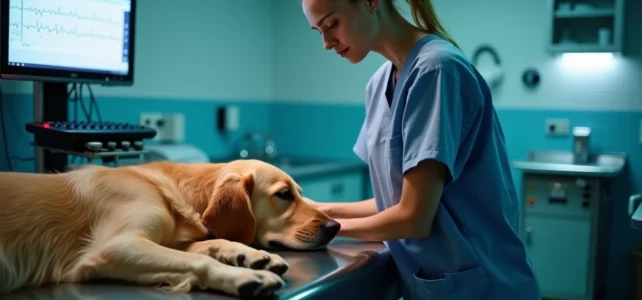
The overnight veterinary care depends on very different levels of organization according to the type of facility. Between a city practice that transfers its calls and a clinic equipped with a continuously open intensive care unit, the care of a hospitalized dog or cat at night is incomparable.
Remote monitoring and continuous monitoring during overnight hospitalization
Veterinary clinics with an intensive care service now use monitoring systems similar to those found in human medicine. Heart rate sensors, pulse oximetry, invasive or non-invasive blood pressure measurement: these devices transmit real-time data to a centralized screen in the on-call room.
The main interest of this monitoring is the early detection of deterioration. An animal on IV fluids whose heart rate drops or whose oxygen saturation decreases triggers an audible alarm. Monitoring does not replace human presence; it complements it. Without trained staff to interpret the data and intervene, the alarm remains useless.
Some facilities add surveillance cameras in the hospitalization boxes. This system allows the night team to check an animal’s behavior (agitation, prostration, vomiting) without opening the cage, which limits stress related to repeated handling. An article detailing who monitors animals at night at the veterinarian helps to better understand this daily operation.
On-call veterinarian: regulatory obligations and on-site presence
A frequent confusion persists between “on-call” and “standby.” In a 24/7 on-call clinic, a veterinarian must be physically present on-site, not just reachable by phone. This obligation distinguishes on-call facilities from standard practices that only provide a simple nighttime phone standby.
In the case of standby, the veterinarian is at home and travels if a call justifies it. The animal hospitalized in this type of practice remains alone between closing and opening the next day, unless a veterinary technician (ASV) ensures a round. We recommend asking the question directly before any hospitalization: “Will my animal be physically monitored tonight?”
The role of the night veterinary technician
In clinics that maintain a night team, the night ASV is the first link in monitoring. Their tasks cover a wide spectrum:
- Administer prescribed treatments (injections, IV fluids, assisted feeding) according to the protocol established by the on-call veterinarian
- Conduct regular rounds to check the clinical status of each hospitalized animal, note vital parameters, and report any anomalies
- Ensure the comfort of the animals (changing bedding, repositioning patients in recumbency, pain management under veterinary supervision)
- Prepare the surgery room in case of a nighttime emergency intervention
The night ASV is often the person who spends the most time in direct contact with the animal. The on-call veterinarian intervenes based on clinical decisions, but it is the technician who detects the first warning signs during rounds.
The 3115: nighttime regulation of veterinary emergencies
Since 2023, the national number 3115 Veterinary Emergencies allows for free telephone regulation, accessible 24/7. This system directs owners to the nearest on-call veterinarian based on location and the nature of the emergency.
The call, connection, and communication are entirely free regardless of the operator. This number significantly changes the management of nights for pet owners: instead of searching for an open practice by calling multiple numbers, the regulation identifies the appropriate facility (on-call clinic, veterinary hospital center, home visit).
We observe that this service also modifies the workload of night clinics. The regulation filters non-urgent calls and redirects to a consultation the next day when the situation allows, freeing up time for critical hospitalized cases.
Levels of overnight monitoring according to the type of veterinary facility
Not all clinics offer the same degree of vigilance. Understanding these differences allows for an informed choice when overnight hospitalization is considered.
| Type of facility | Night presence | Monitoring |
|---|---|---|
| Veterinary practice (standby) | No on-site presence, veterinarian reachable by phone | Animal alone, no active monitoring |
| Clinic with passive on-call | ASV on-site, veterinarian on standby | Regular rounds, call the veterinarian if needed |
| 24/7 clinic or hospital center | Veterinarian and ASV on-site at all times | Continuous monitoring, intensive care available |
The cost of overnight hospitalization varies greatly depending on this level of monitoring. A facility with a full team on-site logically charges more than a practice where the animal spends the night without human presence. Prices are free and differ from one establishment to another.
What to ask before overnight hospitalization
Before entrusting an animal for the night, three questions help clarify the situation:
- Will a veterinarian or ASV be physically present in the clinic during the night?
- How often are monitoring rounds conducted?
- In case of sudden deterioration, what is the veterinarian’s intervention time (immediate if on-site, or travel time if on standby)?
This information is not always available on the clinic’s website. Asking the practitioner directly before hospitalization remains the most reliable way to assess the level of nighttime care.
The quality of overnight monitoring primarily depends on the organizational model chosen by the facility. An animal hospitalized in a veterinary center with a permanent night team benefits from an unmatched responsiveness compared to a practice on standby. Knowing the clinic’s operation before the emergency avoids unpleasant surprises when a decision needs to be made quickly.