
The minimum area for compulsory contribution (SMA) is the threshold of cultivated area from which a farmer is mandatorily subject to the agricultural social protection scheme managed by the MSA. This threshold, set by prefectural order in each department, varies according to the type of production and geographical area.
Since the Future of Agriculture Law of 2014, the SMA is no longer the only criterion. It is part of a broader framework called minimum activity for compulsory contribution (AMA), which combines area, working time, and professional income.
Minimum activity for compulsory contribution: three criteria, not just one
Before 2015, affiliation to the non-salaried agricultural scheme was primarily based on the minimum installation area (SMI). The reform resulting from the law of October 13, 2014, replaced this system with the AMA, a three-pronged mechanism. Understanding this structure avoids reasoning solely in hectares.
Affiliation as an operator or agricultural business owner is triggered as soon as one of the following three criteria is met:
- The minimum area for compulsory contribution (SMA): the cultivated area must be at least equal to the departmental SMA. For livestock or specialized crops, equivalences convert the herd or production into theoretical area.
- Working time: when the area cannot serve as a reference (mushroom farms, off-ground workshops, agricultural service businesses), the activity must represent at least 1,200 hours per year.
- Professional income: if neither the area nor the working time is met, agricultural professional income equal to or greater than the regulatory threshold still allows for affiliation.
The concept of minimum area for MSA contribution remains central, but it is no longer the only entry point into the agricultural scheme.
Departmental SMA: why the threshold varies from one territory to another
The SMA is not a single national figure. Each prefect sets, by order, a threshold adapted to local agronomic realities. A mixed crop-livestock farm in a lowland department does not have the same economic potential per hectare as a hillside vineyard or a sheep farm in a mountainous area.
This differentiation results in significant disparities between departments. Prefectural orders also publish equivalence tables by type of production: a number of beehives, heads of livestock, or square meters of greenhouses corresponds to a fraction of the SMA. A goat farmer in Allier and a market gardener in Nord-Pas-de-Calais do not read the same grid.
Mountain areas and corrective coefficients
In mountainous regions, lower yields and climatic constraints often lead to lower SMAs than those in lowland areas, to reflect the lower productivity per hectare. The MSA Alpes du Nord, for example, publishes distinct thresholds according to the departments under its jurisdiction and according to the altitude of the plots.
Before any action, the first step is to consult the prefectural order in effect in the department where the farm is located. This document is available from the prefecture, the agricultural chamber, or directly on the local MSA website.
Solidarity contributor or farm manager: the quarter SMA threshold
Not reaching the full SMA does not mean escaping all obligations to the MSA. As soon as an operator cultivates at least a quarter of the SMA, they fall into the category of solidarity contributors. This intermediate status involves paying a solidarity contribution, but it does not grant the same rights as full affiliation.
The difference has significant social consequences:
- The solidarity contributor does not benefit from health, maternity, or retirement coverage under the agricultural scheme for their activity.
- The fully affiliated farm manager contributes more but accumulates rights to basic and supplementary retirement, family benefits, and daily allowances in case of accident or illness.
- In partnership or co-farming, the activity of each non-retired partner is taken into account to determine if the affiliation threshold is crossed, which can change the status of all members.
A project holder who intentionally sizes their farm just below the SMA to limit their contributions must weigh what they lose in social protection. The solidarity contribution remains due, but the coverage obtained in return is minimal.
Regional schemes and local equivalences: the impact of recent orders
The reading of the SMA does not occur in isolation. The regional master plans for agricultural operations (SDREA) influence the practical interpretation of thresholds. In Brittany, a new framework came into effect on January 1, 2024. It sets equivalences by type of production and a threshold for authorization to operate that overlaps with the SMA for structural control.
This intersection between social law (MSA) and structural law (SDREA) sometimes creates situations where a farm meets the SMA without obtaining the authorization to operate, or vice versa. Compliance with the SDREA does not exempt from checking the MSA threshold, and vice versa.
Case of diversified activities and multi-active individuals
An operator who combines production activities, on-farm processing, and tourist accommodation (rural gîte, educational farm) may see their agricultural working time counted beyond just the cultivated area. The MSA includes these activities, known as extensions of the production act, in the overall calculation of the AMA.
For a multi-active individual, the criterion of professional income often becomes the most relevant. If the income derived from agricultural activity exceeds the regulatory threshold, affiliation is required even without reaching the SMA in area.
Check your situation before committing
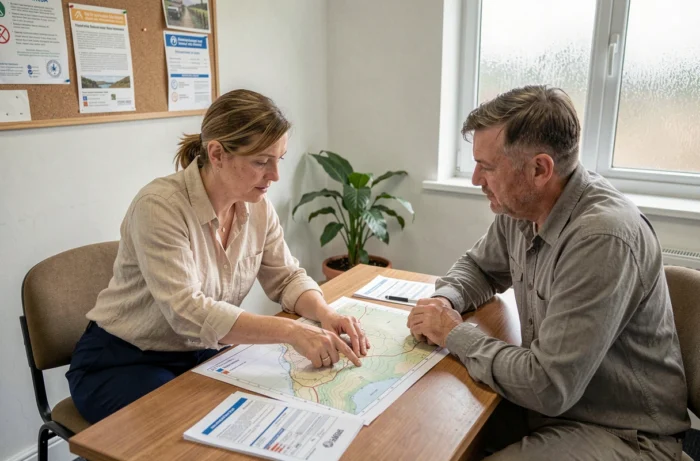
Anyone considering taking over or starting a farm should request a simulation from their departmental MSA fund. The fund has the up-to-date prefectural order, equivalence tables, and can project the status (solidarity contributor or farm manager) based on the described project.
The agricultural chambers also offer support during the installation process, including a social aspect that incorporates the calculation of the AMA. Anticipating this calculation avoids unpleasant surprises regarding the level of contributions and the actual extent of the social coverage obtained.