
The duration of palliative care does not coincide with that of the terminal phase. Confusing the two can delay care and deprive patients of support that may begin months, sometimes years, before death. The 2024–2034 ten-year strategy confirms this approach by incorporating palliative care from the early stages of a serious illness, alongside curative treatments.
Decline trajectories and anticipating the need for palliative care
Three main decline trajectories determine when palliative support becomes appropriate. The cancer trajectory is characterized by a relatively stable functional state followed by rapid deterioration over a few weeks. The organ failure trajectory (heart failure, COPD, kidney failure) involves alternating exacerbations and partial recoveries over several months, with each episode leaving the patient at a slightly lower level of functioning. The frailty or dementia trajectory involves a slow, prolonged decline that is difficult to predict.
For each of these trajectories, prognosis cannot establish a precise timeframe. Healthcare professionals may estimate how much time remains, but this estimate is primarily used to guide patients toward a palliative care program. What the care team can provide is a range of reasonably anticipated outcomes, from the best to the worst plausible scenario.
A detailed article discusses the duration of palliative and end-of-life care in relation to these trajectories, helping to better determine when to begin palliative care.
Clinical signs of the terminal phase: recognition and timing
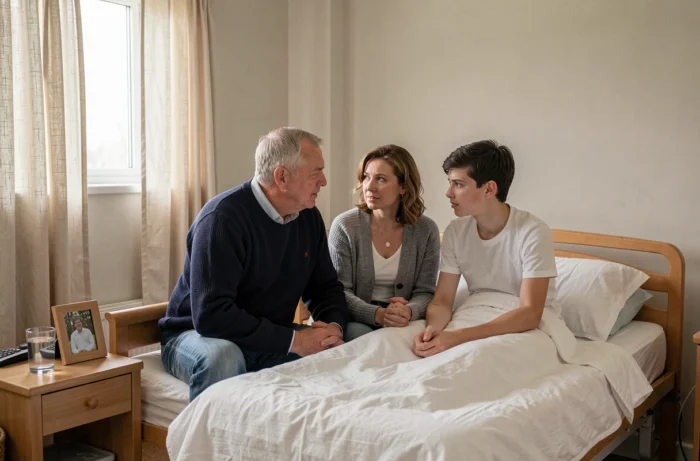
The terminal phase is distinguished from the rest of the palliative care journey by identifiable clinical signs. They do not appear according to a fixed schedule, but together they can help care teams recognize when a patient is entering their final days.
- Changes in consciousness: increasing drowsiness, confusion, and a gradual decrease in responsiveness to verbal and tactile stimuli.
- Respiratory changes: irregular breathing, pauses (apnea), and death rattle caused by a buildup of secretions in the upper airways.
- Peripheral circulatory failure: mottled skin, cold, bluish extremities, and a weak, thready pulse.
- Stopping oral food and fluid intake: the patient no longer expresses thirst or hunger, and swallowing becomes difficult or impossible.
These signs do not all occur at the same time. Some patients develop mottling several days before their breathing changes. Others remain conscious almost until the end. This variability makes it difficult to establish a rigid timeline, which is precisely why recognition relies on clinical assessments by the bedside team several times a day.
Palliative care at home or in a care facility: what changes in the care provided
The care setting changes the nature of support without changing its goals. At home, hospital-at-home services (HAD) coordinate visits from community healthcare professionals, mobile palliative care teams and, sometimes, trained volunteers. In Île-de-France, ORS data show that most deaths occur in hospital, reflecting a gap between patients’ often-expressed wish to remain at home and the resources actually available.
Access to palliative care expertise depends on how local care pathways are organized. Since the ministerial directive issued in June 2023, these pathways have been expected to connect specialist teams, community-based professionals and health and social care providers to facilitate earlier access. Where the pathway is well established, patients benefit from smooth coordination between their primary care physician and the specialist team. Where it is still in its early stages, palliative care is often introduced late, sometimes only in the final days.
Supportive care homes: an intermediate model
The 2024–2034 ten-year strategy provides for the creation of supportive care and palliative care homes for people who do not need continuous hospitalization but can no longer remain at home. In Île-de-France, a pilot project has been announced in Versailles, with opening planned for 2027. This model aims to fill the gap between home (which may not offer enough medical support) and hospital (which is often more intensive than needed for comfort-focused care).
Communicating with patients and loved ones during palliative care
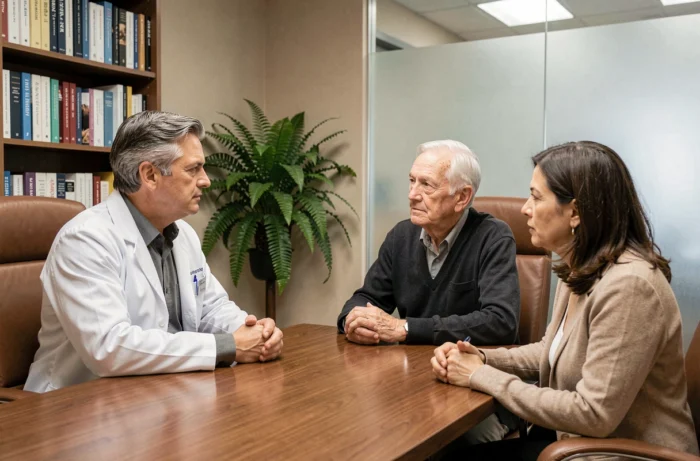
Communication in palliative care is about more than sharing a prognosis. It shapes the entire care journey: reviewing treatment goals, discussing advance directives and providing psychological support to loved ones.
Prognoses should be given as ranges, not dates. Saying “a few weeks to a few months” is more reliable and respectful than giving a precise figure that will almost always be wrong. Families given an overly narrow prognosis may live in fear of the countdown. Those given an overly broad prognosis may struggle to prepare.
Supporting loved ones is an integral part of palliative care. The 2024–2034 ten-year strategy explicitly addresses the psychological and social needs of family and friends, not just those of the patient. Dedicated consultations, bereavement support offered after a death and the presence of support volunteers complement medical care.
Symptoms treated in palliative care: more than pain
Pain remains the most feared symptom, but palliative care addresses a much broader range of needs:
- Dyspnea: a feeling of breathlessness common in lung and heart conditions, treated with low-dose opioids, positioning and non-invasive ventilation when appropriate.
- Nausea and vomiting: caused by cancer progression, treatments or liver failure, and managed with antiemetics suited to the underlying cause.
- Terminal agitation and anxiety: managed with proportionate sedation, or deep and continuous sedation if symptoms remain refractory to all other treatments.
- Bronchial secretions: managed with gentle suctioning or medication to reduce secretions, depending on the patient’s comfort.
Each symptom is regularly reassessed by the multidisciplinary team. The care plan is never set in stone: it adapts to clinical changes and the patient’s wishes for as long as they can express them.
Palliative care neither shortens life nor artificially prolongs it. Its legal framework, strengthened by recent end-of-life legislation, ensures that every treatment decision is focused on comfort and dignity and made in agreement with the patient and their loved ones.